
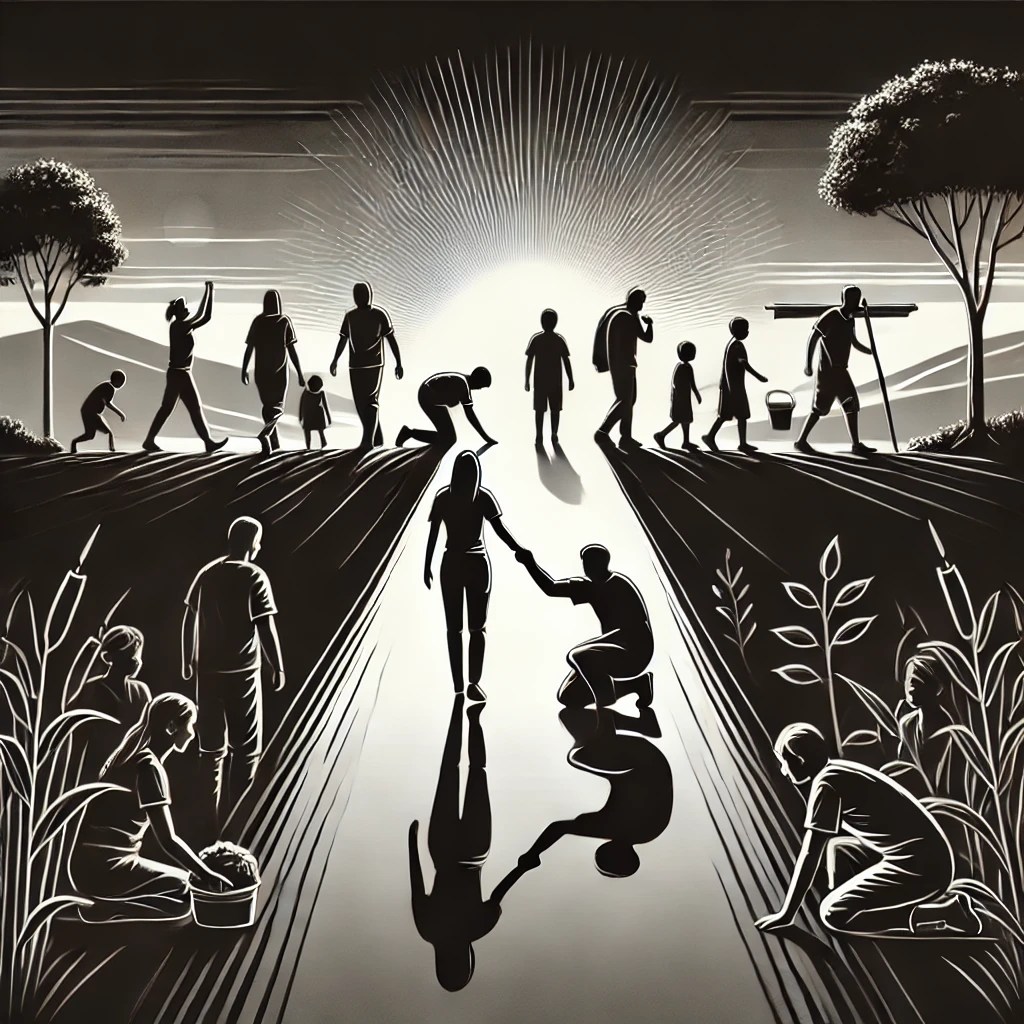
I want to tell you about two moments I witnessed that capture the essence of what it means to walk The Path. The first happened on a cold morning in Detroit, where I watched a restaurant owner named James open his kitchen early to feed people who had lost their homes in an apartment fire. He didn’t know them. They weren’t his customers. But there he was, at 4 AM, making breakfast, offering coffee, treating each person with dignity and respect.
The second moment occurred in a high school classroom, where a teacher had written a simple question on the board: “Why do we help others?” The students’ discussion that followed wasn’t about heaven or hell, divine rewards or punishments. Instead, they talked about our shared humanity, about how helping others makes our whole community stronger. They understood something profound: that compassion isn’t a command from above, but a natural expression of our deeper understanding of each other.
These moments reflect the core teachings that Jesus shared two thousand years ago, teachings about mercy, compassion, and standing up for those in need. But here’s what’s remarkable: these principles don’t require supernatural belief to be true. They’re verified by human experience, confirmed by research, and demonstrated in communities worldwide.
Let me share with you what The Path looks like in action, not through lists or rules, but through the lives of people who embody these principles every day.
Consider Sarah, an emergency room doctor I met. She spoke about treating everyone who comes through her doors with equal care and respect, regardless of their background or ability to pay. “It’s not about religion,” she told me. “It’s about recognizing our common humanity.” Her words echo Jesus’s parable of the Good Samaritan, but her actions are grounded in medical ethics and human dignity.
Or take the story of the Thompson Street neighborhood. When developers tried to buy out a block of affordable housing, the community didn’t just protest. They organized. They pooled resources, created a community land trust, and preserved homes for families who had lived there for generations. They understood that challenging systemic unfairness isn’t just a moral imperative; it’s a practical necessity for building sustainable communities.
Let me share what I’ve observed about recognizing The Path in our own lives and communities. These aren’t abstract guidelines. They’re patterns I’ve witnessed in how people and communities face real challenges.
I watched a community debate about building a new homeless shelter. Some opposed it based on rumors and fears about crime and property values. But others approached it differently. They asked: What does the research tell us about homeless shelters and community impact? What have other cities learned? What do the people who would use this shelter actually need? They visited existing shelters, spoke with homeless individuals, consulted urban planners and social workers. This is how you recognize The Path: it shows in how you approach life’s challenges.
The contrast becomes even clearer in how communities handle education. I visited two school board meetings in different districts. In one, parents were demanding the removal of books they hadn’t read based on social media rumors. In the other, parents organized reading groups to actually examine the books in question, invited experts to discuss child development, and worked to understand different perspectives. The first group relied on fear and assumption; the second walked The Path of understanding and evidence.
You see The Path most clearly in times of crisis. When severe drought hit a farming community, some called it divine punishment or just bad luck. Others began studying climate patterns, consulting agricultural scientists, and working to implement sustainable farming practices. One farmer told me, “We can pray for rain, but we also need to understand why the rain patterns are changing and what we can do about it.” That’s The Path: combining hope with action, faith with understanding.
In healthcare decisions, The Path becomes starkly clear. I observed two families facing similar medical challenges. One rejected evidence-based treatments in favor of unproven alternatives promoted on social media. The other researched extensively, consulted multiple medical professionals, and made informed decisions based on the best available evidence. Walking The Path doesn’t mean blindly accepting authority. It means engaging thoughtfully with expertise.
You can recognize The Path in how communities handle disagreement. When a conflict arose in one Assembly over how to use their shared space, I watched carefully. Those on The Path didn’t just argue for their position. They asked questions, sought to understand opposing views, looked for evidence about what would serve the community best. They brought in experts on community space design, studied how other groups had solved similar challenges, and worked to find solutions that addressed everyone’s needs. Those who had strayed from The Path made assumptions, spread rumors, relied on “that’s how we’ve always done it.”
Here’s another way to recognize The Path: Watch how people respond to suffering. When a natural disaster struck a coastal town, some said “it’s God’s will” or “it’s just bad luck.” But others asked: What does science tell us about preventing such disasters? How can we help those affected? How do we build more resilient communities? They studied building codes, consulted climate scientists, and worked to create better emergency response systems. That’s The Path: seeking understanding and taking action rather than accepting fate or supernatural explanations.
The Path shows clearly in how communities address poverty. Some see it as inevitable or blame the poor for their circumstances. Those on The Path study economic systems, examine successful anti-poverty programs, and work to address root causes. I watched one Assembly transform from charity-based food distribution to creating job training programs, financial literacy classes, and small business incubators, all based on research about what actually helps people escape poverty.
You can recognize The Path in how people share knowledge. Those who claim special insight without evidence, who say “just trust me” without explanation, have wandered off The Path. But those who show their work, who admit what they don’t know, who invite questions and discussion are walking The Path. I observed a science teacher who didn’t just teach facts but showed students how we know what we know, encouraged them to question everything, and helped them design their own experiments.
In mental health support, The Path becomes evident. Some communities still treat mental health challenges as character flaws or spiritual failures. Those on The Path study psychology, neuroscience, and evidence-based treatments. They create support groups based on proven therapeutic approaches, work to reduce stigma through education, and help connect people with professional care.
The Path reveals itself in how communities handle change. When a factory closed in a small town, some residents just blamed foreigners or government policies. Others studied economic trends, researched successful community transitions, and worked to develop new opportunities. They didn’t just react with anger or despair. They sought to understand and adapt.
In The Assembly, these principles come alive through action. When a local food bank was struggling to meet increasing need, Assembly members didn’t just donate food. They created community gardens, taught cooking classes, and built a network of mutual support that addressed both immediate needs and long-term food security. They understood that ethical principles mean nothing without practical application.
The Path teaches us to look beyond surface appearances, to judge actions rather than people, to seek wisdom through reflection and experience. I watched this understanding unfold in a restorative justice program, where victims and offenders met face to face. One young man, facing the store owner he had robbed, found himself not condemned but listened to, not rejected but invited into a process of healing and restoration. This is forgiveness in action: not forgetting the wrong, but creating space for transformation.
The way forward isn’t marked by supernatural signs or divine interventions. It’s illuminated by the practical wisdom of treating others as we wish to be treated, of extending kindness even to those who wrong us, of building communities where everyone has enough and no one is left behind.
Walking The Path means asking ourselves hard questions: Are we showing mercy when it would be easier to condemn? Are we standing up for the vulnerable when it would be safer to stay silent? Are we sharing resources when we could hoard them? Are we seeking to understand others when we could judge them?
But here’s what’s beautiful about The Path: we don’t walk it alone. Every person who chooses compassion over indifference, understanding over ignorance, generosity over greed, lights the way for others. Every Assembly that creates space for learning, healing, and growth strengthens our collective journey toward a more ethical world.
The evidence for this approach surrounds us. Communities that practice these principles show lower crime rates, better health outcomes, stronger social bonds, and greater resilience in facing challenges. These aren’t miracles. They’re the natural results of putting wisdom into practice.
As we conclude our journey through The Testament, remember this: The Path isn’t about reaching some distant spiritual destination. It’s about how we walk together, here and now, creating communities where wisdom and compassion shape our choices, where understanding leads to action, and where every person has the opportunity to contribute to our shared well-being.
The way forward is clear, not because it’s marked by supernatural signs, but because it’s illuminated by the accumulated wisdom of human experience and the demonstrated results of ethical action. Will you join us on this journey? Will you help light the way for others? The Path awaits, and every step forward makes our world a little bit better, a little more just, a little more worthy of our highest aspirations.
Let’s walk The Path together...
 The Path
Leave a comment