
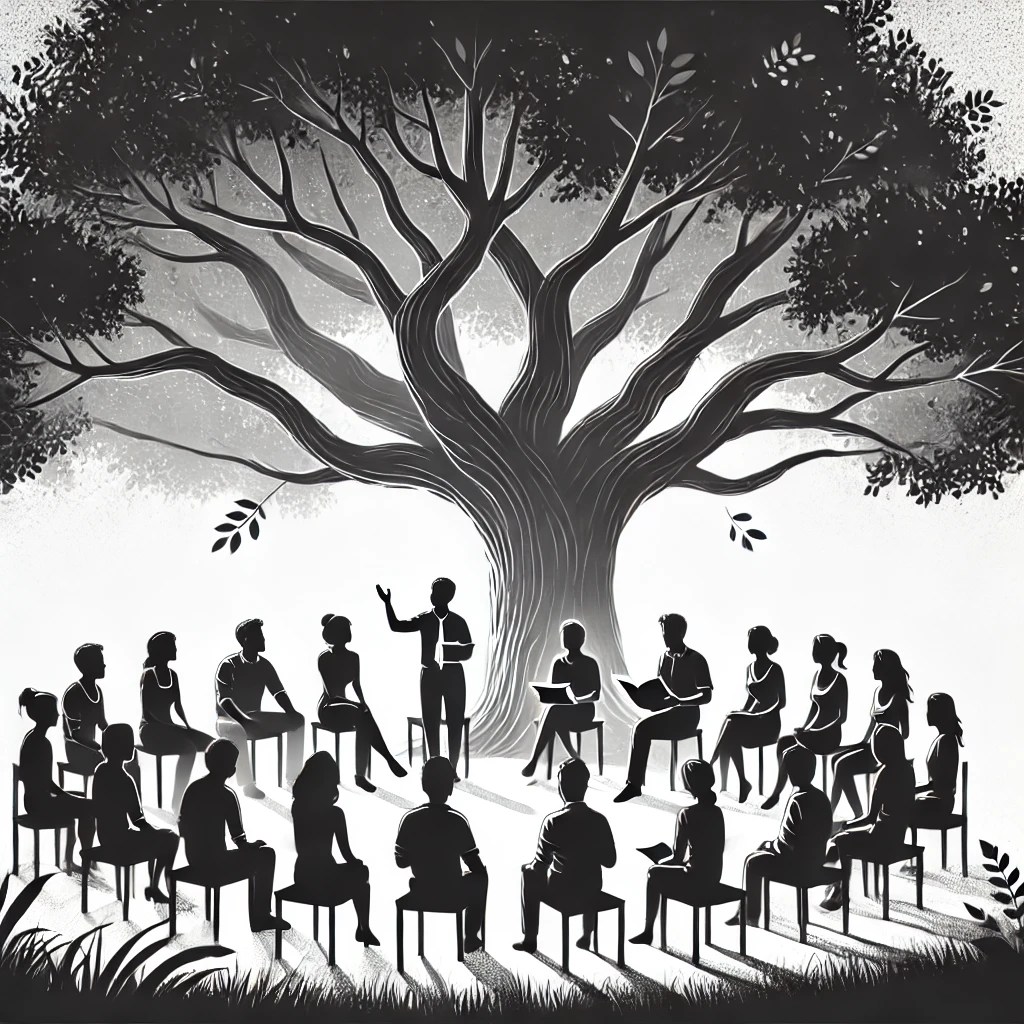
Imagine a scene that has played out across millennia: a circle of seekers gathered around a teacher, the air thick with possibility. Now picture this same scene in countless variations: under a spreading oak tree, in a quiet living room, in a bustling marketplace, in a corporate boardroom. The faces change, the settings shift, but something essential remains constant: the profound human drive to learn and to share wisdom.
Two thousand years ago, a carpenter’s son sat on a mountainside, teaching lessons that would echo through centuries. His words were simple yet revolutionary: love your enemies, care for the vulnerable, seek justice, live with integrity. He taught not through force but through stories that revealed deeper truths. A farmer sowing seeds became a lesson about nurturing growth. A shepherd seeking one lost sheep illustrated the value of each individual. A small measure of yeast showed how subtle influences could transform entire communities.
Today, we continue this tradition of teaching through The Path, not as a set of rigid doctrines but as a living practice that evolves while remaining rooted in timeless wisdom. Whether you stand before a classroom, lead a corporation, or simply wish to learn and grow, these principles offer a framework for authentic development and meaningful impact.
Every teacher (whether parent, mentor, leader, or friend) holds a sacred trust. Their words and actions shape not just individual lives but the future itself. This responsibility requires a framework that ensures our teaching serves the highest good while remaining grounded in practical reality.
Consider the Circles of Impact, a framework that guides both what we teach and how we teach it. At the broadest level, we ask: Does this teaching serve the highest good? Does it align with the fundamental principles that sustain life and promote flourishing? A teacher operating at this level helps students see beyond immediate concerns to understand their role in the greater tapestry of existence.
Picture Marina, a science teacher explaining climate change. She doesn’t just present facts. She helps students understand their connection to Earth’s living systems. Her lessons naturally flow from universal principles to practical actions, showing how individual choices ripple outward to affect the whole.
Every lesson must consider our relationship with the natural world. How do our teachings help preserve and enhance the environment that sustains us? This isn’t just about explicit environmental education. It’s about embedding ecological awareness into everything we teach.
James, a business instructor, weaves sustainability principles into every lesson about profit and growth. His students learn to measure success not just in quarterly earnings but in generational impact. They understand that true prosperity cannot come at the expense of the planet’s health.
Teaching must serve the advancement of all humanity, not just select groups. This means examining our lessons for hidden biases, ensuring they promote unity while respecting diversity, and helping students understand their role in human progress.
Sarah, leading an Assembly discussion about local development, helps participants consider how their decisions might affect different communities. She draws on Jesus’s teachings about caring for the marginalized, showing how ancient wisdom applies to modern challenges.
Good teaching strengthens the bonds between people and enhances local resilience. How do our lessons help build stronger, more supportive communities? This level requires us to consider the practical application of knowledge in local contexts.
Think of David, a community organizer teaching conflict resolution. He uses real neighborhood issues as teaching material, helping people learn to navigate differences while strengthening relationships. His work embodies Jesus’s teachings about reconciliation and peace-making.
Teaching must support family bonds while helping families evolve and grow. How do our lessons help create healthier family dynamics? This intimate level of teaching requires special sensitivity and understanding.
Elena teaches parenting classes that blend modern psychology with timeless wisdom about compassion and forgiveness. Her students learn practical skills while understanding the deeper principles that make families strong.
Finally, teaching must support each person’s unique development journey. How do our lessons help individuals realize their full potential while remaining connected to larger purposes?
To be a student on The Path is to embrace a journey of continuous growth. This journey requires more than just absorbing information. It demands a transformation of heart and mind. The Learning Path provides a framework for this sacred journey.
Every learning journey begins with the question “Why?” Not just “Why am I learning this specific skill?” but “Why am I here? What is my role in the greater story of life?” This deeper questioning aligns with Jesus’s emphasis on understanding our purpose in serving others and creating positive change.
Consider Maya, a young professional studying leadership. Her initial goal was career advancement, but through The Path, she discovered a deeper purpose: learning to lead in ways that uplift others and serve the greater good. Her studies took on new meaning when connected to this larger purpose.
True learning reveals the interconnected nature of all things. Students learn to see how their actions affect not just their immediate surroundings but ripple outward to touch the whole web of life. This understanding naturally leads to more conscious choices and actions.
Thomas, studying economics, began to see how financial decisions affect not just profit margins but community wellbeing, environmental health, and social justice. His understanding of value expanded beyond monetary measures to include all forms of impact.
Knowledge becomes wisdom through application. Students on The Path constantly ask, “How can I use this to serve?” This question transforms learning from a passive process into an active force for positive change.
When Lisa learned about food systems, she didn’t just write papers. She started a community garden that now feeds dozens of families and teaches children about sustainable agriculture. Her learning immediately translated into community benefit.
Practical skills matter. The Path encourages students to develop concrete capabilities while understanding how these skills serve larger purposes. This combines Jesus’s emphasis on practical service with the need for competence in action.
Miguel, learning carpentry, develops technical expertise while understanding how his work can create safe, beautiful spaces for families to thrive. His skill-building is guided by awareness of its broader impact.
Learning must lead to action. Students are encouraged to apply their knowledge in real situations, starting small but thinking big. This echoes Jesus’s teaching that faith without works is dead.
Rachel, studying conflict resolution, practices her skills first in small family disagreements, then in community mediation, and eventually in larger social justice initiatives. Each step builds on the last while serving ever-wider circles.
Continuous reflection allows for deeper learning and course correction. Students regularly assess their progress not just in terms of knowledge gained but in light of their impact on all levels of the Circles of Impact.
The principles of teaching on The Path naturally create strong leaders in all fields. Whether guiding a classroom, a corporation, or a community initiative, these principles foster leadership that serves the highest good while achieving practical results.
True leaders, like great teachers, embody the values they teach, making their decision-making process clear and aligned with universal principles. Their institutional values reflect their personal commitment to integrity and service. They demonstrate moral courage in standing for what’s right, combined with the perseverance to overcome obstacles. They show how to maintain ethical standards while navigating real-world challenges.
Following Jesus’s example, they lead through suggestion and story rather than command. They trust in people’s capacity to understand and choose wisely when shown the way. They ignore petty attacks while addressing significant challenges, demonstrating how to maintain purpose and dignity in the face of opposition.
They maintain faith in people’s potential even when they fail, offering guidance and support rather than judgment. This reflects Jesus’s teachings about forgiveness and human dignity. They remain students themselves, continuously growing and adapting while staying true to core principles. Their humility enhances rather than diminishes their authority.
They make complex ideas accessible without oversimplifying them. They help others grasp profound truths through clear communication and practical application. And they demonstrate that serious purpose doesn’t require somber delivery. They show how to find joy in growth and service.
The true power of these frameworks emerges in their practical application. Consider how they guide decision-making at every level. A teacher designing a curriculum first considers universal principles, then environmental impact, then societal benefit, working through each circle to create lessons that serve all levels of impact. A manager making strategic decisions uses the same framework, ensuring choices serve not just profit but all stakeholders, from employees to the environment.
Social initiatives are evaluated for their effects at each level, from immediate impact to long-term societal benefit. Individuals use these frameworks to guide their own development, ensuring their growth serves not just personal but universal good.
As the sun sets on our gathering under the oak tree, the lessons continue to resonate. Teaching and learning on The Path isn’t just about transferring information. It’s about participating in the growth of consciousness itself. Every teacher becomes a student, every student becomes a teacher, and together we work toward the flourishing of all life.
This is how wisdom grows through generations: not through rigid transmission of fixed knowledge, but through living engagement with eternal principles. Whether in classrooms or boardrooms, families or communities, these frameworks offer guidance for growth that serves the highest good while meeting practical needs.
The Path forward is clear, though not always easy. It requires commitment to continuous growth, courage to face challenges, and compassion for ourselves and others as we learn. Yet this is how we create the future we wish to see: one lesson, one choice, one action at a time, guided by frameworks that keep us aligned with universal good while grounded in practical reality.
Let’s walk The Path together...
 The Path
Leave a comment