
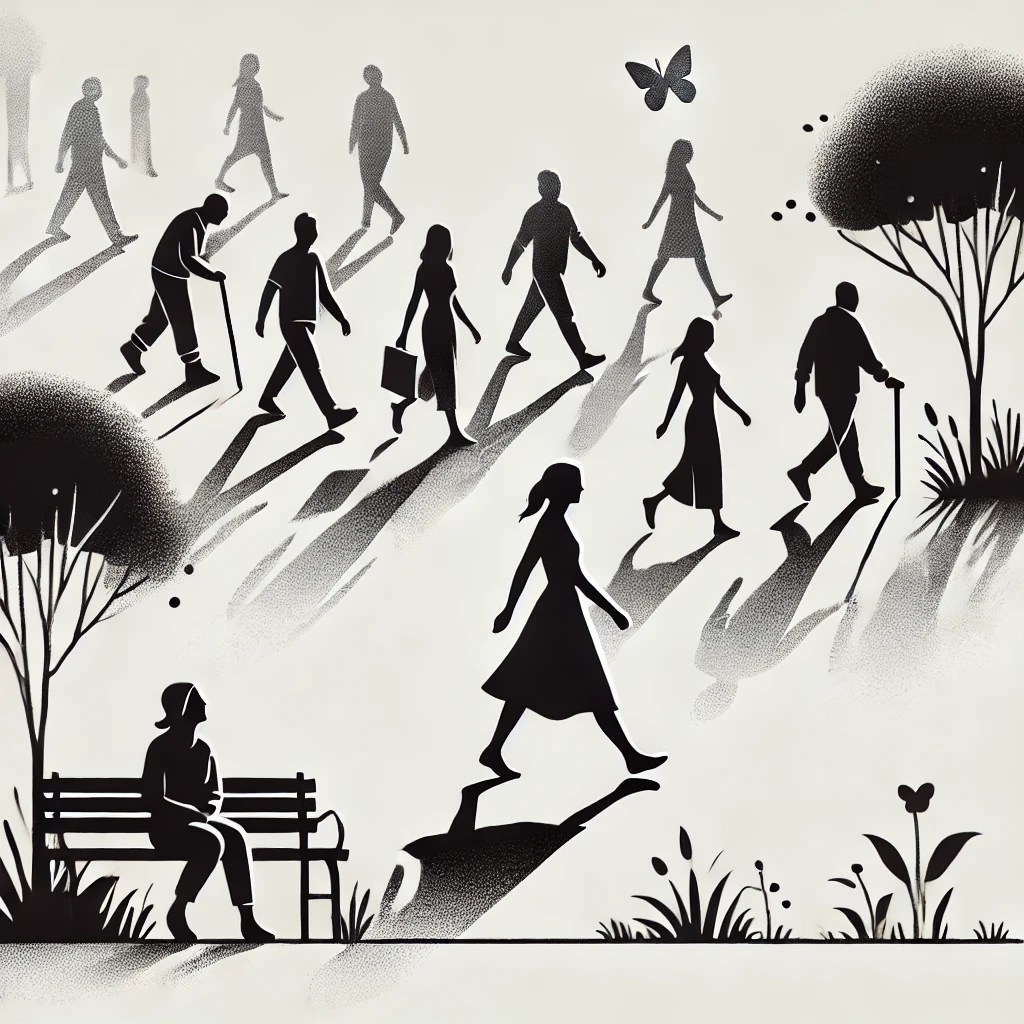
The sound of laughter drifts through the air as a group gathers in a park for their weekly walk. Some move briskly, chatting animately, while others stroll at a leisurely pace, enjoying the crisp morning air. Among them is Michael, once trapped in a cycle of working too much, drinking too much, sleeping too little. Today his eyes are clear, his step light. His transformation didn’t come through any miracle cure or divine intervention, but through the simple yet profound practice of taking responsibility for his own wellbeing.
Personal responsibility. These words sound simple, perhaps even obvious. Yet in their depths lie the keys to a life well-lived. To be responsible isn’t just about paying your bills on time or showing up for work. It’s about something far more fundamental: the recognition that your choices shape not only your own life but ripple outward to touch countless others.
Consider your body. This remarkable collection of cells and systems isn’t just a vehicle that carries you through life. It’s the instrument through which you experience the world, contribute to your community, and express love for others. When we neglect our physical health (through poor nutrition, lack of movement, inadequate rest), we diminish our capacity to serve. When we abuse substances or seek escape through addiction, we’re not just harming ourselves; we’re withdrawing from our responsibilities to those who depend on us.
Sarah, a teacher in our Assembly, shares her story. “I used to think taking care of myself was selfish,” she says, her voice steady. “I worked endless hours, survived on coffee and vending machine snacks, told myself I was being dedicated. Then one day, I couldn’t get out of bed. My body had simply said: enough.” Her journey back to health began with a simple realization: she couldn’t take care of her students if she couldn’t take care of herself.
Yet personal responsibility extends far beyond physical health. Consider how you view others. Do you see them as fully human, with dreams and struggles as complex as your own? Or do you reduce them to objects: obstacles in your path, tools for your advancement, or targets for your judgment? This subtle shift in perception changes everything. When you truly see the humanity in others, it becomes impossible to gossip carelessly about them, to exploit them for personal gain, to dismiss their pain as irrelevant to your life.
Consider that homeless man you passed this morning, the one you pretended not to see. What stories did you tell yourself to justify walking by? “Someone else will help.” “He’ll just spend it on drugs.” “I’m too busy right now.” These are moments of self-deception, comfortable lies we tell ourselves to avoid the discomfort of responsibility.
Picture David, a successful businessman who once prided himself on his busy schedule. Every day he drove past a homeless encampment, windows rolled up, eyes straight ahead. Then one morning, something changed. “I realized I was seeing objects instead of people,” he shares in an Assembly. “Once I truly saw them as human beings, with stories and struggles as complex as my own, I couldn’t look away anymore.” Now David dedicates part of each week to working with homeless outreach programs, not from guilt but from genuine connection.
In the quiet of an Assembly gathering, James speaks of his battle with anger. “I was always looking for someone to blame,” he admits. “The rich for their greed, the powerful for their corruption, my neighbors for their success. My anger felt righteous, justified. But it was eating me alive.” Through The Path, James learned to transform his anger into action, his resentment into resolve. He still works for social justice, but now from a place of clarity rather than rage.
Think about your relationship with money and possessions. Both greed and bitter envy arise from the same illusion: that happiness comes from accumulating more. The Path teaches a different way. True wealth isn’t measured in bank accounts but in the richness of your connections, the depth of your contributions, the integrity of your choices. This doesn’t mean ignoring financial responsibility. Quite the opposite. It means managing resources wisely, living within your means, sharing generously, and refusing to let either abundance or scarcity define your worth.
Even in our closest relationships, self-deception can blind us to our responsibilities. When your partner asks you to cut the grass, it’s easy to see it as an interruption, an imposition on your time. “I’ll do it later,” you say, while inwardly resenting the request. But The Path invites us to look deeper. That uncut grass isn’t just about aesthetics. It’s about shared responsibility, about showing through actions that you value your partner’s needs and contribute to your home’s wellbeing.
Sarah, a relationship counselor in our Assembly, puts it this way: “Every request from a loved one is an opportunity to either strengthen or weaken your connection. When we dodge these small responsibilities, we’re not just avoiding a task. We’re sending a message about what we value.”
In business, personal responsibility takes on another dimension. Consider two sales representatives: one sees customers as quarterly targets, the other sees them as human beings with real challenges seeking real solutions. The first focuses on closing deals; the second focuses on understanding needs and providing genuine value. Their results differ not because of superior sales techniques, but because of superior seeing: the ability to recognize and respond to human needs authentically.
Marcus, a veteran sales manager, shares his revelation: “I used to train my team in persuasion tactics. Now I train them in empathy. When you truly understand your customer’s pain points, when you genuinely care about solving their problems, sales happen naturally. But more importantly, you build relationships that last.”
Marina, a successful executive, describes her shift in perspective: “I used to chase bigger deals, bigger bonuses, bigger houses. Now I ask different questions: Am I creating value for others? Are my business practices sustainable? Am I using my resources to strengthen my community?” Her redefinition of success has transformed not only her own life but the culture of her entire organization.
Our responsibility to the Earth follows the same principle. It’s easy to think, “My individual choices don’t matter much,” or “Someone else will solve the climate crisis.” These are just more forms of self-deception. The truth is, every plastic bag you accept, every unnecessary car trip you take, every resource you waste matters. These choices multiply across billions of people and generations of time.
Elena, an environmental scientist, tells her Assembly about the transformation in her neighborhood: “It started with one family composting. Then another joined, then another. Now we have a community garden fed by our collective compost, teaching our children about cycles of renewal. One small choice rippled outward to change dozens of lives.”
Personal responsibility includes how you show up in relationships. Every interaction (whether with family, friends, colleagues, or strangers) is an opportunity to practice integrity, express compassion, demonstrate respect. The words you speak, the tone you use, the promises you keep or break: all of these shape the web of connections that support not just you but entire communities.
Consider your digital life. In an age of constant connectivity, personal responsibility extends to how you behave online. Do your posts spread truth or misinformation? Do your comments build up or tear down? Do you use technology as a tool for connection and learning, or as an escape from authentic engagement with life?
The Path teaches that personal responsibility includes tending to your mental and emotional health. This means developing the skills to regulate your emotions, the wisdom to process your experiences, the courage to face your shadows. It means seeking help when you need it, offering support when you can give it, and recognizing that mental health is as crucial as physical wellbeing.
Thomas, a recovering addict, shares his insight: “I used to think freedom meant doing whatever I wanted. Now I understand that true freedom comes from making conscious choices, from being response-able: able to respond to life’s challenges with clarity and purpose.” His words remind us that personal responsibility isn’t a burden but a path to liberation.
In our Assembly gatherings, we practice these principles together. We share struggles and successes, offer support without judgment, celebrate progress without demanding perfection. We recognize that personal responsibility doesn’t mean going it alone. It means being accountable within a community of shared values and mutual care.
As the day draws to a close, imagine reviewing your choices. Did you see people as people, or as obstacles and objects? Did you meet responsibilities with resentment or recognition of their deeper meaning? Did you contribute to the healing or the harming of our shared Earth? Personal responsibility means living in such a way that you can answer these questions with clarity and integrity.
The Path forward requires constant vigilance against self-deception, continuous renewal of our commitment to see clearly and act responsibly. Whether facing a business decision, a family obligation, or a stranger in need, the question remains the same: Will you choose the comfortable lie or the transformative truth? Will you see objects or people? Will you withdraw into self-concern or expand into genuine care for others and our shared world?
The choice, as always, is yours. But remember: every choice shapes not just your life but the vast web of connections that hold our world together. Choose wisely, choose consciously, choose with the understanding that personal responsibility is the foundation of all positive change.
Let’s walk The Path together...
 The Path
Leave a comment