
You know, I’ve spent countless hours observing how penguins brave the harshest conditions on Earth, walking miles across Antarctic ice, all for love. But here’s something remarkable: that same force that drives those penguins exists in every human heart, though we often forget its power.
Picture, if you will, a mother in a crowded refugee camp. She’s gone without food for two days, yet she shares her last piece of bread with a stranger’s child. That’s not just kindness. That’s love in its purest form. You see, love isn’t just about romance or family ties. It’s a force as fundamental as gravity, shaping how we move through this world and connect with others.
In The Path, we understand that love isn’t some mystical force bestowed by divine intervention. It’s a natural phenomenon, as real as the neurons firing in your brain right now, as tangible as the air you’re breathing. Science shows us that when we connect with others, our bodies release oxytocin, dopamine, and serotonin, nature’s way of rewarding cooperation and bonding. But that’s just the beginning of the story.
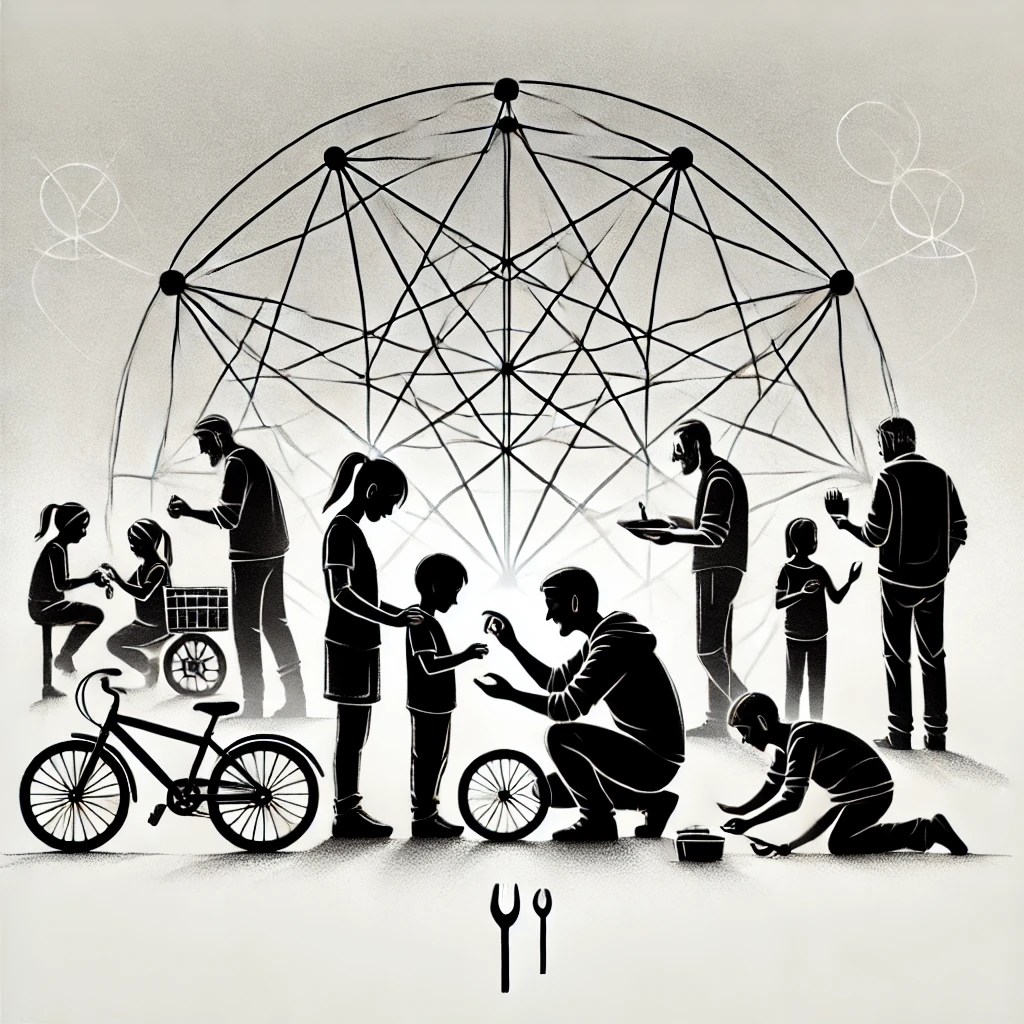
Let me tell you about Marcus, a construction worker I met. Every day after his shift, he spends an hour teaching young kids in his neighborhood how to repair bicycles. “It’s not just about the bikes,” he told me, his hands covered in grease. “It’s about showing these kids that someone cares enough to spend time with them.” You see, love isn’t always about grand gestures. Sometimes it’s built in small moments, one connection at a time.
Think about how a spider builds its web. Each strand might seem fragile on its own, but together they create something remarkably strong. That’s how love works in communities. Every small act (a neighbor checking on an elderly resident, a teenager helping a lost child find their way home, a stranger offering their umbrella during unexpected rain) weaves the threads that hold society together.
Now, here’s something fascinating about love: it’s the only resource that multiplies when you share it. Imagine a candle lighting another candle. The first flame doesn’t diminish; instead, there’s more light in the world. Neuroscience shows us how this works in our brains. When we express love and receive it, our capacity for empathy actually grows. Our neural pathways strengthen, making it easier to form connections in the future.
Let me share something powerful with you. In downtown Detroit, there’s a community garden where former gang members work alongside the families of victims of gang violence. They didn’t start with forgiveness. They started with tomatoes. But as they worked the soil together, something remarkable happened. They began to see each other as human beings, not as enemies or victims. That’s love doing what it does best: breaking down walls we thought were permanent.
In The Path, we recognize that love evolves. It’s not static. Take David and James, for example. They were bitter rivals in their law firm for fifteen years. Then they found themselves working together on a pro bono case defending a homeless shelter from demolition. Today, they’re not just friends. They run a nonprofit together, providing legal aid to vulnerable communities. Their story shows us that love can grow in the most unexpected places, transforming competition into collaboration.
Here’s a truth that might surprise you: love requires courage. It’s easier to stay disconnected, to protect ourselves from potential pain. But take a moment to consider the Japanese art of kintsugi, where broken pottery is repaired with gold. The cracks become part of the beauty. When we dare to love despite our fears of being hurt, we create something more beautiful than perfection. We create authenticity.
In my travels, I’ve witnessed love speak in countless languages. I’ve seen it in the hands of a deaf-blind teacher in Nepal, helping her students feel the world through touch. I’ve watched it in the actions of a former neo-Nazi who now works to help others leave hate groups behind. Love speaks through actions, transcending words, beliefs, and boundaries.
Recent studies in quantum physics show us something remarkable: at the smallest level, everything is connected. Particles that have once interacted remain linked, regardless of distance. It’s as if the universe itself is teaching us about the fundamental nature of connection. In The Path, we don’t need supernatural explanations for love. The natural world provides all the wonder we need.
Consider this: when astronauts see Earth from space, they often experience what’s called the Overview Effect, a cognitive shift where national boundaries disappear, and they see humanity as one interconnected family. Love has the power to create this same shift in perspective, helping us see beyond our artificial divisions.
As we conclude this chapter, remember this: love isn’t just something that happens to us. It’s something we choose to create every day. In The Path, we understand that love is both our origin and our destination. It’s the force that lifted our ancestors out of mere survival into cooperation and community. It’s the power that will carry us forward into a future worth creating.
Whether you’re building bridges with former enemies, sharing your last piece of bread with a stranger, or simply teaching a child to fix a bicycle, you’re participating in something profound: the ongoing story of human connection. And that story, my friends, is the greatest story ever told.
Let’s walk The Path together...
 The Path
Leave a comment