
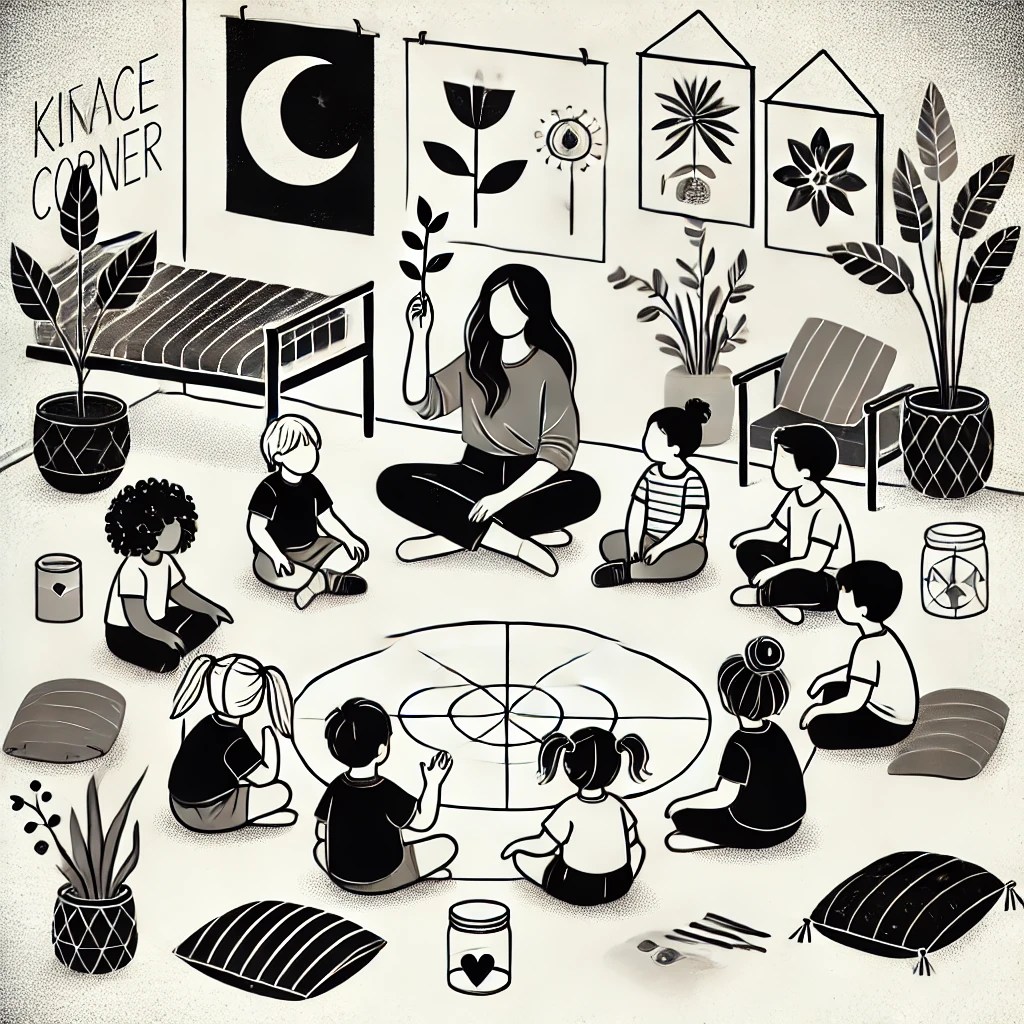
Sarah sits cross-legged on the floor, surrounded by eight eager faces. The children, ages 7-11, wiggle with barely contained energy, yet their eyes are fixed on her. She’s about to begin today’s story about two friends who had a fight over a video game, but instead of getting revenge, one friend found a way to make things better. The children lean in – they’ve all had fights with friends, they’ve all felt the pull between getting even and making peace. This is how we teach wisdom to young hearts.
I want to share with you what I’ve learned from watching our most skilled children’s Assembly teachers. Notice how differently Maria opens her group compared to Tom’s with the teenagers down the hall. “Friends,” she says, holding up a small potted plant, “who can tell me what this seed needs to grow?” The children eagerly list sunshine, water, good soil. “You’re right! And just like this plant, we all need certain things to grow into our best selves. That’s why we’re here together – to learn how to grow strong and kind and wise.”
The Art of Teaching Children
Let me tell you about David’s first children’s Assembly. He had prepared a serious talk about honesty, complete with statistics about trust in society. Five minutes in, he saw the glazed looks, the fidgeting bodies. Then he remembered his own childhood and shifted gears: “Want to hear about the time I found a twenty-dollar bill at the park?” Suddenly, every child was engaged. Through his story about deciding to turn the money in to the park office, and the surprise of meeting the grateful elderly woman who had lost it, the children learned more about honesty than any lecture could teach.
Young minds learn best through:
- Stories that mirror their experiences
- Activities that engage their bodies
- Questions that spark their curiosity
- Examples they can relate to
- Opportunities to practice what they learn
Creating the Learning Space
Watch how Marina transforms her Assembly room before the children arrive. In one corner, there’s a “peace corner” with soft cushions where children can go to calm down or think. Art supplies are readily available for children who process through drawing. A small table holds a plant they’re growing together and a jar where they collect written kindnesses they’ve witnessed.
“Your space,” Marina explains, “should feel both exciting and safe. Children need to know they can be themselves here – energetic, curious, sometimes struggling, always growing.”
The Flow of a Children’s Assembly
Let me walk you through a typical session:
Opening Circle (10 minutes): Today Marina begins with the “weather report” – each child shares how they’re feeling using weather words. “I’m partly cloudy because my brother was mean this morning.” “I’m sunny because I helped my mom make breakfast!” This simple check-in helps children recognize and express their emotions while practicing empathy for others’ feelings.
Story Time (15 minutes): Stories are our most powerful teaching tools, but they must be chosen carefully. Instead of tales of supernatural intervention, we tell stories of real human courage, kindness, and growth. Let me share some that consistently engage young minds:
- “The Lunch Table Choice” – A story about Emma, who notices a new student eating alone. She wants to sit with him but worries her friends might tease her. Through Emma’s decision-making process, children explore courage, kindness, and standing up for what’s right.
- “The Birthday Money Decision” – Miguel receives twenty dollars for his birthday and sees a classmate’s lunch money being stolen. His struggle over whether to share his birthday money opens discussions about generosity and helping others.
- “The Truth About the Window” – A story about a group of friends playing ball who accidentally break a window, and how one child’s honesty changes everything. This leads naturally into discussions about integrity and taking responsibility.
Active Learning (20 minutes): Children need to move, to do, to experience. Here’s how skilled teachers engage the whole child:
- For teaching empathy: The “Walking in Someone’s Shoes” activity, where children try to cross the room while imagining different challenges – being elderly, having a hurt leg, carrying something heavy. This physical experience makes abstract empathy concrete.
- For teaching cooperation: The “Human Knot” game, where children must work together to untangle themselves without letting go of hands, leads naturally into discussions about patience, communication, and helping each other.
- For teaching forgiveness: The “Crumpled Paper Heart” activity, where children crumple a paper heart when sharing things that hurt feelings, then try to smooth it out, learning that while we can forgive, actions leave marks we should think about.
Understanding Different Age Groups
In Maria’s Assembly, you’ll notice she adapts her approach based on age. Let me show you how this works through her story about sharing:
- For Ages 5-7: She brings in two stuffed animals who both want to play with the same toy. The children act out different solutions, physically experiencing the concepts of sharing and taking turns. “Remember how Bear and Rabbit learned to play together? When has sharing been hard for you?”
- For Ages 8-11: The story evolves into a situation about sharing limited time on the playground basketball court. The discussion explores fairness, leadership, and creative problem-solving. “What could the older kids do to make sure everyone gets a chance to play?”
- For Ages 12-14: The same principle is explored through relevant scenarios like sharing family resources or managing group projects at school. “How do you balance your needs with others’ needs? What makes sharing difficult sometimes?”
Stories That Teach
Here’s a collection of real-life stories that capture children’s attention while teaching core principles:
- The Playground Hero: “Last week, I saw a third-grader notice a kindergartner who fell during recess. While other kids kept playing, she stopped to help. What do you think made her pause? How do you decide when to stop what you’re doing to help someone?”
- The Homework Truth: “Jamie forgot to do his math homework. When his teacher asked about it, he had a choice: make up an excuse or tell the truth. Let’s stop the story here – what would you do? Now let’s see what Jamie chose…”
- The Lunchroom Kindness: “Sofia saw that Max never had enough food in his lunch. She could have ignored it. Instead, she started bringing extra carrots and crackers every day. But she never told anyone – she just quietly shared. Why do you think she kept it quiet?”
Making Learning Active
Watch how Tom transforms lessons into experiences:
- Teaching Generosity: The children create “Kindness Kits” – decorating bags and filling them with small useful items for people who might need them. As they work, they discuss: “How do you feel when someone shares with you? What makes it hard to share sometimes?”
- Learning About Community: The group creates a “Helping Map” of their neighborhood, marking places where people might need assistance and brainstorming ways kids their age could help. “Who takes care of the playground? Who helps keep our streets clean? How could we make their job easier?”
- Understanding Consequences: Using a “Ripple Pool” – a container of water where they drop pebbles – children see how one action creates ripples affecting everything around it. They share stories of times when one small action (kind or unkind) led to bigger effects.
Handling Challenging Moments
Let me show you how experienced teachers handle common situations:
- When Attention Wanders: Notice how Sarah responds to restlessness: “Let’s all stand up! Can you show me with your body how a flower grows from a tiny seed?” The physical movement helps children refocus while reinforcing lessons about growth and patience.
- When Conflicts Arise: Maria uses peer conflicts as teaching moments: “It looks like you both want the same marker. Instead of telling you what to do, I’d like to hear your ideas for solving this. What could work for both of you?”
- When Children Share Difficult Things: Tom responds to a child sharing about parents fighting: “That sounds really hard. Thank you for trusting us with your feelings. Would you like to draw a picture about it, or would you prefer to just sit quietly for a moment?”
Creating Home Connections
The learning shouldn’t stop when Assembly ends. Watch how successful teachers extend the impact:
- Family Discussion Starters: Each week, Marina sends home simple questions families can discuss during dinner: “When did you help someone today? What made you laugh? Who might need extra kindness tomorrow?”
- Practice Projects: Children receive small weekly challenges: “Notice one person doing something kind each day” or “Find three ways to help at home without being asked.”
- Parent Partnerships: Regular notes home share what virtues we’re exploring and suggest ways parents can reinforce them: “This week we talked about courage. Ask your child about times they’ve been brave!”
Special Activities That Work
Throughout the year, certain activities become beloved traditions:
- The Gratitude Garden: Children plant real seeds and tend them over weeks, connecting plant growth to their own growth in understanding and kindness. Each week they add paper flowers naming things they’re grateful for.
- The Helping Heroes Wall: Children bring in stories and pictures of people they know who help others – not famous people, but everyday heroes like crossing guards, lunch ladies, or kind neighbors.
- The Peace Path: A physical path marked on the floor that children can walk when they need to work through strong feelings or conflicts, with stations for “Stop and Breathe,” “Name Your Feelings,” “Think of Solutions,” and “Make Peace.”
Closing Each Session
Watch how Maria brings her group to a close:
First, a moment of quiet reflection: “Let’s close our eyes and think about one thing we learned today that we want to remember.”
Then, a sharing circle: Each child completes the sentence “This week I will…” with a specific action they plan to take.
Finally, a closing ritual: Standing in a circle, each child turns to their neighbor and says, “Thank you for sharing and learning with me.”
The Heart of Teaching Children
Remember, you’re not just teaching lessons – you’re helping shape how children see themselves and their place in the world. Your own authenticity, your willingness to share real stories of struggle and growth, your genuine care for each child – these matter more than perfect activities or flawless presentations.
Trust in children’s natural capacity for wisdom and compassion. Create the conditions for these to grow through stories that engage their imagination, activities that involve their whole selves, and discussions that honor their thoughts and feelings.
Most importantly, remember that every child who learns to pause before reacting, to consider others’ feelings, to choose kindness over convenience – they become living seeds of hope for our world’s future. This is the precious work of teaching children on The Path.
 The Path
Leave a comment