
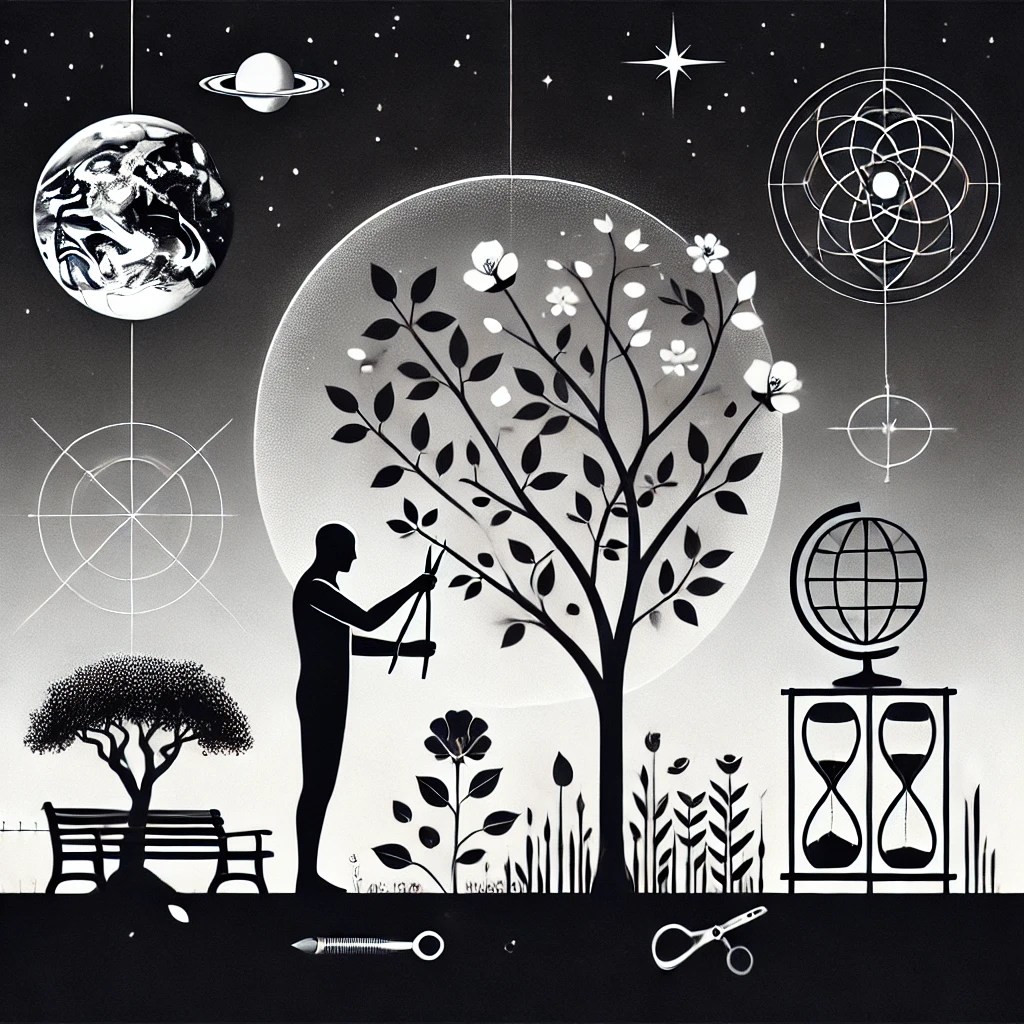
Imagine walking through the Monticello gardens with Thomas Jefferson on a spring morning in 1824. He stops by a flowering dogwood, pulls out his pocket knife, and carefully cuts away a diseased branch. “Nature,” he says, “follows precise laws. Our task is not to pray for divine intervention, but to understand these laws and work within them.”
Jefferson, like many of America’s founders, was what we call a Deist. He saw the universe as operating according to natural laws, laws that could be discovered through reason and observation. This understanding helped shape a revolution, not just in governance, but in how humans could relate to the divine without sacrificing their reason.
The story of Deism begins with a simple but profound observation: the universe operates in consistent, knowable ways. The same gravity that drops an apple on Earth keeps planets in their orbits. The same principles of cause and effect that we observe in a chemistry experiment govern the formation of stars. This consistency suggests a rational foundation to existence itself.
Early Deists like John Toland and Matthew Tindal recognized something revolutionary: that if there is a Creator, this Creator must be discoverable through reason and observation, not just through claimed revelations or ancient texts. They saw that the best way to honor such a Creator would be to study and understand the natural world.
In the 1700s, this was radical thinking. The prevailing view saw God as constantly intervening in human affairs, sending floods as punishment, granting victories in battle, choosing kings and rulers. Deists broke from this view. They argued that if the universe was created with rational laws, then looking for supernatural interventions was missing the point. The miracle wasn’t in the breaking of natural law, but in the existence of natural law itself.
This shift in perspective changed everything. Instead of praying for rain, people began studying weather patterns. Instead of attributing disease to divine punishment, they investigated causes and cures. This wasn’t a rejection of the divine. It was a more profound way of appreciating it through understanding rather than superstition.
Today, The Path builds on this Deistic foundation while taking it further. Like the Deists, we see the universe as operating according to natural laws that we can study and understand. But where traditional Deism often stopped at acknowledging a Creator and studying nature, The Path recognizes that understanding brings responsibility.
When we comprehend how ecosystems work, we become responsible for protecting them. When we understand how societies function, we become responsible for making them more just. When we learn how human psychology operates, we become responsible for creating healthier communities.
From Deism, we inherit several crucial insights. First, that truth should be verifiable through reason and evidence. The universe isn’t playing tricks on us. It operates according to principles we can discover and understand. Second, that we honor whatever force brought the universe into being by studying and understanding it, not by claiming special revelations or supernatural interventions.
Consider how this plays out in an Assembly. When discussing climate change, we don’t pray for divine intervention. We study the science, understand the systems involved, and work to address root causes. When helping someone through grief, we don’t offer supernatural comfort. We share what psychology and neuroscience have taught us about processing loss, while providing the community support that research shows aids healing.
Traditional Deism often stopped at philosophical contemplation. Many Deists concluded that since God had created a perfect universe with perfect laws, human intervention was unnecessary or even presumptuous. The Path recognizes this as an abdication of responsibility. Understanding without action is incomplete.
We also move beyond the 18th-century Deistic conception of a clockmaker God who created the universe and then stepped away. Modern physics shows us a quantum universe where the line between observer and observed, between creator and created, is far more complex than early Deists imagined. The Path embraces this complexity while maintaining the core Deistic commitment to understanding through reason and evidence.
In The Assembly, you might hear echoes of Deistic thought when we discuss the wonder of natural law, or when we emphasize understanding over blind faith. But you’ll also hear something new: a call to action based on that understanding. We study natural laws not just to admire them, but to work more effectively within them to create positive change.
The quantum physicist who marvels at wave-particle duality isn’t just contemplating nature’s mysteries. She’s working to develop technologies that could transform clean energy production. The psychologist who studies human behavior patterns isn’t just observing. He’s developing better ways to help people overcome trauma and build healthier relationships.
Deism represented a crucial step in human spiritual evolution: the recognition that we could relate to the divine through reason rather than superstition. The Path takes the next step, recognizing that understanding brings responsibility. We honor the rational universe not just by studying it, but by using our understanding to make it better.
When Jefferson tended his garden, he didn’t just observe natural laws. He worked within them to create something beautiful and useful. Similarly, The Path calls us to be both students and stewards of the natural world and human society. We study to understand, and we understand to act.
As we face modern challenges (climate change, technological revolution, social transformation), we need both the Deistic commitment to rational understanding and The Path’s emphasis on responsible action. We need communities like The Assembly where people can explore the mysteries of existence while working together to solve practical problems.
The next time you look up at the stars, remember: their light reaches us through natural laws we can understand. But that understanding isn’t the end of the journey. It’s the beginning. The Path invites us to take what we learn from studying the universe and use it to light the way forward for humanity.
 The Path
Leave a comment