
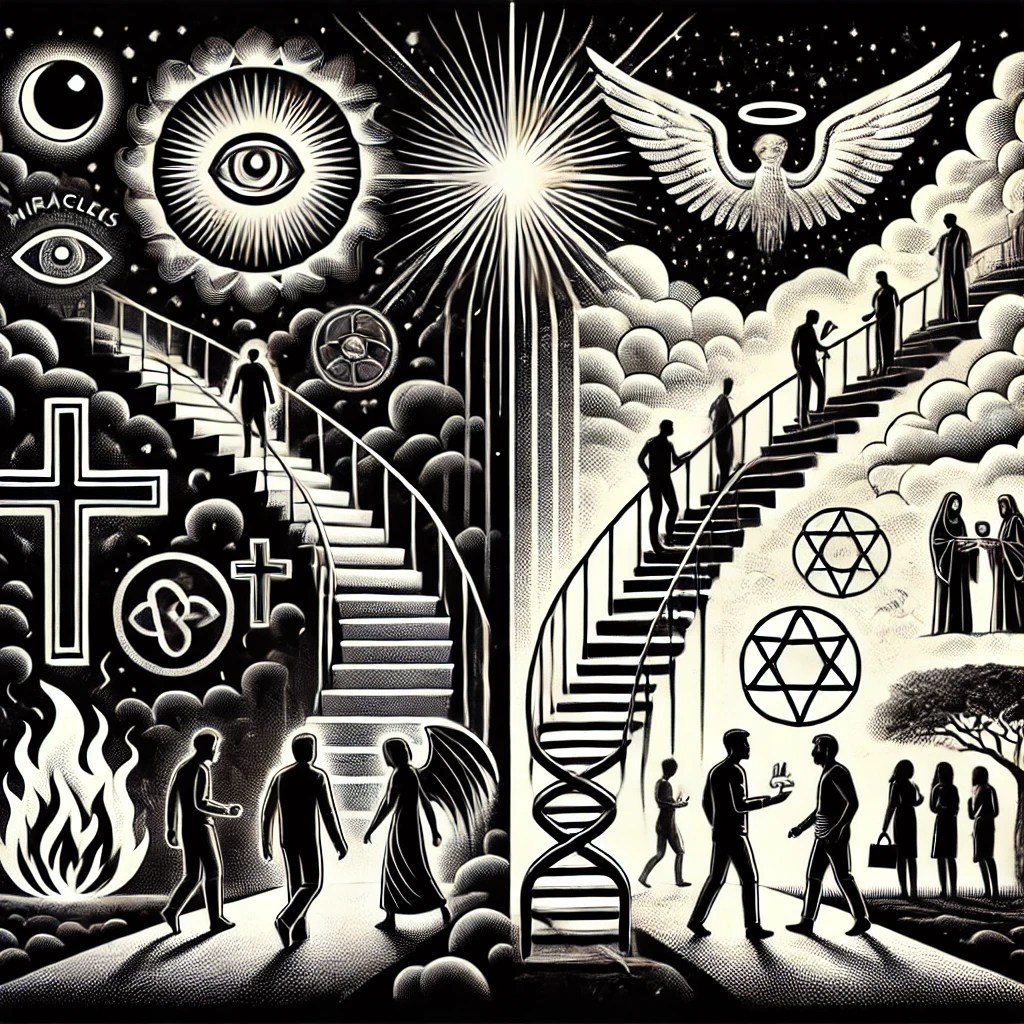
Let me tell you about two mothers teaching their children not to steal. The first says, “Don’t steal because an all-seeing God will punish you eternally.” The second explains, “Don’t steal because it harms our community and betrays trust.” Both aim for the same outcome, but the first message comes with built-in enforcement that requires no understanding—just fear and belief.
This simple example illuminates something profound about how supernatural claims and the fear of divine punishment aided Christianity’s spread. You see, when you promise eternal rewards and threaten eternal punishment, you’re engaging powerful psychological mechanisms that bypass the need for deeper understanding.
Consider what happens in the human brain when confronted with the idea of hell. Studies show that fear of eternal punishment activates our deepest survival instincts. It’s immediate, visceral, and requires no complex ethical reasoning. A child might not understand why betraying trust damages community bonds, but they can instantly grasp the fear of burning forever.
The virgin birth and miracles serve a different but equally powerful psychological function. Our brains are wired to remember the extraordinary, the impossible. A teacher sharing wisdom about compassion might be easily forgotten, but a teacher walking on water? That story burns itself into memory, carrying its moral lessons along with it.
But here’s what’s fascinating about supernatural beliefs: they also provide immediate comfort in a way that reason and understanding often cannot. When a loved one dies, “They’re in a better place” offers instant emotional relief. “Their atoms will rejoin the cosmic cycle” might be more accurate, but it doesn’t soothe the grieving heart as quickly.
The success of supernatural claims in spreading Christianity also lies in their unverifiability. You can’t prove heaven doesn’t exist, just as you can’t prove it does. This psychological limbo creates what psychologists call “cognitive dissonance,” which often leads people to strengthen their beliefs rather than question them. After all, what if you’re wrong and hell is real? The potential cost seems too high.
Divine oversight serves another crucial psychological function: constant surveillance. Research shows that even subtle reminders of being watched change human behavior. An all-seeing God becomes an internalized supervisor, monitoring thoughts and actions even when no other humans are present. This is remarkably effective at maintaining social order, requiring no police, no prisons—just belief.
The promise of heaven also taps into our need for justice in an unfair world. When the poor see the wealthy living in luxury while they struggle, “They’ll get theirs in hell, and you’ll be rewarded in heaven” provides immediate psychological relief without requiring systemic change. It’s a powerful way to maintain social order while promising future compensation for present inequality.
Supernatural beliefs also create strong group bonds through shared, unprovable claims. When you believe something that can’t be verified, maintaining that belief often requires social reinforcement. This creates tight-knit communities united by shared faith, which in turn makes the belief system more attractive to others seeking belonging.
Now, this presents a genuine challenge for movements like The Path. How do you build equally strong communities and ethical frameworks without these psychologically powerful tools? How do you motivate good behavior without divine surveillance? How do you comfort the grieving without promises of reunion in heaven?
The answer lies in a deeper understanding of human nature and community. Yes, supernatural beliefs offer quick comfort and easy answers. But they also infantilize us, relying on fear and reward rather than genuine understanding. They provide emotional band-aids rather than true healing, quick fixes rather than real solutions.
The power of The Path lies precisely in its challenge: to face reality as it is, to find meaning without mythology, to build ethics on understanding rather than fear. This requires more effort, more thought, more genuine growth. But it leads to something more valuable: authentic wisdom that doesn’t depend on unprovable claims.
Is this harder to spread than supernatural beliefs? Absolutely. It’s easier to say “God is watching” than to explain how ethical behavior builds stronger communities. It’s easier to threaten hell than to help people understand the natural consequences of their actions. It’s easier to promise heaven than to create justice on Earth.
But here’s what’s remarkable: when people do embrace ethics based on understanding rather than supernatural claims, they tend to maintain them more steadily. Why? Because understanding, once achieved, doesn’t depend on maintaining belief in unprovable claims. It stands on its own merits, verifiable through experience.
The challenge for The Path isn’t to find supernatural replacements for heaven and hell. It’s to demonstrate that genuine understanding, authentic community, and evidence-based ethics offer something more valuable than comfortable myths: a way of living that works because it’s true, not because we’re afraid of divine punishment or hoping for divine rewards.
Remember this: while supernatural beliefs might spread more easily, wisdom based on understanding spreads more surely. The Path’s challenge is to help people discover that real transformation, though harder won, is more valuable than any supernatural promise.
 The Path
Leave a comment