
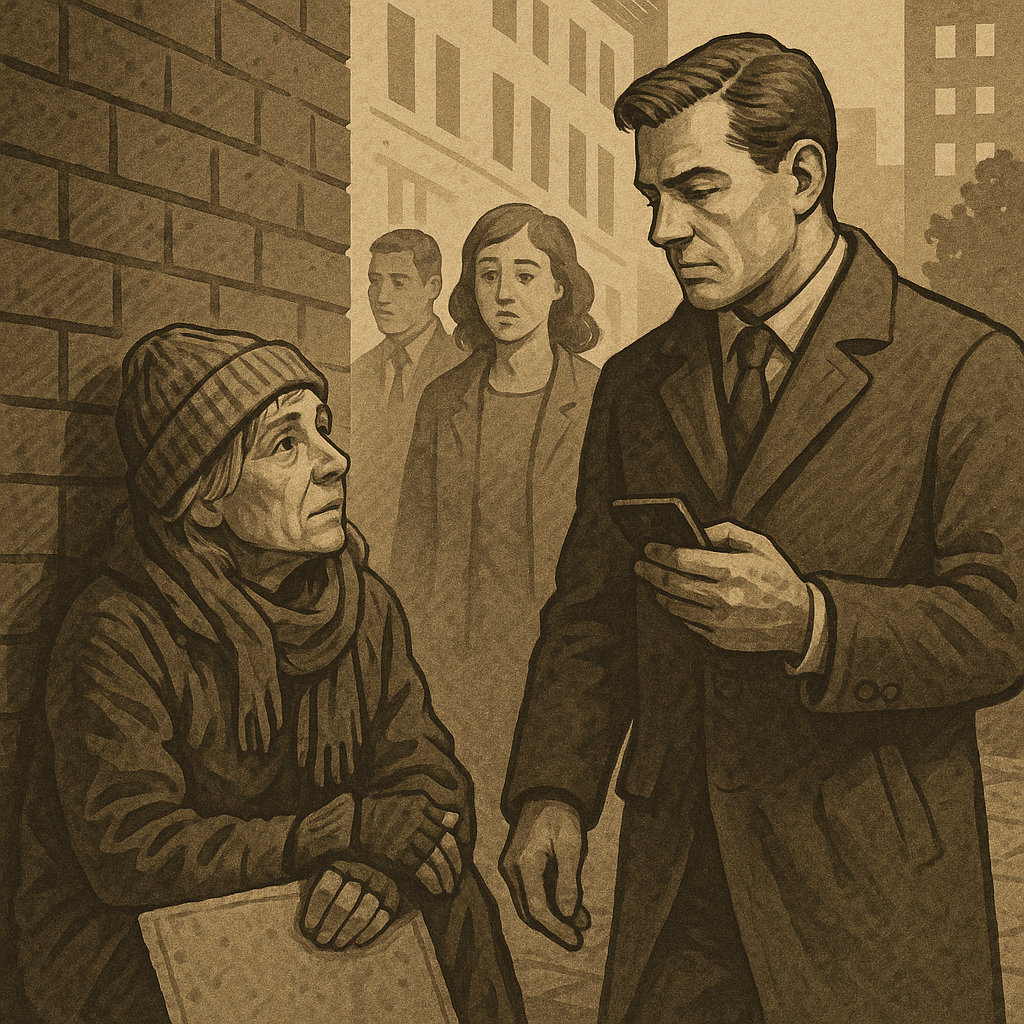
I was walking through downtown San Francisco one cold Tuesday morning, the fog still clinging to the buildings like reluctant dreams. The sidewalk bustled with people clutching coffee cups, their breath visible in the chill. That’s when I saw her.
She sat on a piece of flattened cardboard, her weathered hands wrapped in fingerless gloves, a small cardboard sign propped beside her. Her eyes, clear blue against her wind-reddened face, watched the passing parade of humanity. And then came the businessman, Italian leather shoes clicking purposefully on the concrete. His cashmere coat was the color of expensive chocolate, his attention fixed on his phone. As he approached the woman, something remarkable happened. Without breaking stride or looking up, he curved his path around her, a perfect, practiced arc that required no conscious thought. His body recognized her presence while his mind refused to. In his reality, she existed only as an obstacle, not as a person with a name, a history, a collection of hopes and losses.
I watched her face as he passed. There was no surprise there, no fresh hurt, just the quiet dignity of someone accustomed to invisibility. And in that moment, I understood something profound about our moral failings. They aren’t just things we do, they’re ways we see or refuse to see.
Every day, in countless moments, we commit these small betrayals of our shared humanity. Not because we’re evil or broken, but because we’re human, with all the complexity that entails.
Traditional religions might call these moments sins, moral ledger entries that require divine forgiveness. But The Path offers a different understanding, one rooted in what we know about the human brain, about trauma, about the psychology of connection and disconnection.
“The greatest moral failing isn’t doing wrong, but refusing to see rightly.” This understanding changes everything about how we address our ethical blind spots.
Let me tell you about Elena. A marketing executive with a corner office, Elena prided herself on her progressive values. She donated to the right causes, shared the right posts, expressed the right outrage at dinner parties. Yet every evening as she worked late, Elena would barely acknowledge Martin, the man who emptied her trash and vacuumed her office floor.
During an Assembly gathering (a Sunday afternoon meeting in someone’s living room, sunlight streaming through windows, the scent of coffee and homemade bread in the air), Elena shared this realization. Her voice trembled slightly as she admitted, “I know Martin’s face, but not his story. I see his function, not his humanity.”
There were no judgmental glances, no clearing of throats. Instead, nods of recognition rippled through the circle. Others shared similar patterns, the way they avoided eye contact with the homeless man at the subway entrance, how they bristled when seated near “difficult” family members at holidays, their silent rage at political opponents.
“What we’re talking about,” said the facilitator, his voice gentle in the quiet room, “is the box. That mental construction that separates us from others, that classifies some people as fully human and others as something less.”
The Assembly didn’t stop at recognition. They moved to understanding and then to action. For Elena, this meant a simple commitment: learn three things about Martin that had nothing to do with his job. The following week, she returned with eyes bright with discovery.
“Martin has three grandchildren he’s putting through college,” she shared, her voice warm with admiration. “He paints landscapes that he sells at local art fairs. And he makes the best tamales in Oakland, his grandmother’s recipe.” Elena paused, emotion catching in her throat. “I’ve passed him five days a week for three years and never knew he contained worlds.”
You could feel the shift in the room, not just for Elena but for everyone present. Something opened. Something connected. Something healed.
“The path to seeing others as fully human begins with allowing ourselves to be fully seen.” The words settled in the room like a benediction.
This approach to moral failings stands in stark contrast to frameworks of sin and redemption. The Path recognizes that the businessman stepping around the homeless woman isn’t evil, he’s disconnected. Elena wasn’t malicious toward Martin, she was caught in patterns of perception she hadn’t examined.
Consider how we might apply this understanding to other common moral failings:
When we witness indifference to mass incarceration, we see not just a policy issue but a failure of imagination. At one Assembly, this became painfully clear when James, a retired judge, brought letters from incarcerated people to share. As participants took turns reading aloud, their voices sometimes breaking at passages about missing children’s birthdays or learning trades with no opportunity to use them, the statistics transformed into stories. The sound of quiet weeping filled the room when one woman read about a man who hadn’t felt human touch in seven years.
“What changes in us,” asked James, his hands trembling slightly as he collected the letters, “when we allow ourselves to feel the reality of lives we’ve been taught to dismiss?”
The Assembly didn’t just discuss. They acted. Some began corresponding with incarcerated people. Others investigated local bail fund initiatives. James himself started mentoring formerly incarcerated youth, his judicial perspective transformed by human connection.
“Understanding without action is merely intellectual tourism. The Path requires moving our feet, not just our minds.”
Or consider performative altruism, that modern tendency to share social justice posts online while taking no real-world action. Rachel, a college student with a carefully curated social media presence, confronted this disconnect during an Assembly exercise called “From Posts to Practice.” Participants compiled their recent social advocacy posts and then honestly assessed their corresponding actions.
“I’ve shared forty-three posts about environmental justice,” Rachel admitted, her face flushing as she spoke, “but I still use disposable everything, drive when I could walk, and haven’t changed my consumption at all.” The vulnerability in her voice was palpable, her fingers fidgeting with her sleeve. “It’s easier to perform caring than to actually change.”
Instead of shame, the Assembly offered structure. Rachel connected with two other members focused on environmental action. They created a simple accountability system, weekly check-ins, shared goals, celebrated progress. Six months later, Rachel’s apartment tour revealed visible changes: a composting system, secondhand furniture, zero-waste bathroom products. But the real transformation showed in her face, the quiet confidence of alignment between values and actions.
“On The Path, we measure growth not by perfection but by the shrinking gap between what we believe and how we live.”
Environmental apathy, selective compassion, consumerism, classism, racial bystanding, all these moral failings share a common root: the failure to see others as equally real, with lives as complex and valid as our own. And all can be addressed through the same fundamental practices: awareness, understanding, community support, and concrete action.
Let me tell you about Marcus, whose story illuminates how this transformation happens. A corporate attorney with a punishing schedule, Marcus realized during an Assembly discussion that he had begun treating service workers as functions rather than people. The barista existed to produce coffee. The janitor existed to create cleanliness. The security guard existed to ensure safety. None existed as full humans with their own stories.
Marcus decided to learn one personal fact about someone who served him each day. The practice felt awkward at first, intrusive, even. “I felt like I was performing interest rather than feeling it,” he admitted during a follow-up Assembly, the evening light casting long shadows across the circle of attentive faces. “But something shifted after about two weeks.”
The shift came during a brief exchange with Elijah, the barista who made his morning coffee. When Marcus asked about his weekend plans, Elijah mentioned a graphic design showcase featuring his work. The genuine surprise Marcus felt, that this person he’d seen as a coffee-maker was actually an artist with talent and ambition, created a moment of uncomfortable self-awareness.
“I could actually feel my brain recategorizing him,” Marcus explained, his voice thoughtful in the quiet room. “It was like watching my own prejudice dissolve in real time.”
This neurological shift, this rewiring of perception, isn’t mystical transformation. It’s neuroplasticity, the brain’s natural ability to form new connections through experience. When we repeatedly practice seeing others more fully, our perception actually changes. We become unable to unsee humanity.
“The greatest moral growth happens not in grand gestures but in small moments of expanded awareness.”
This is how The Path addresses all moral failings. Not with divine judgment or supernatural forgiveness, but with natural processes of awareness, understanding, and growth. Not with religious ritual, but with practical action. Not with threats of hellfire, but with the promise of a more connected, meaningful life right here and now.
I understand if this approach triggers resistance. It’s uncomfortable to examine our moral blind spots. When Jason, a first-time Assembly participant, heard others discussing their selective compassion, caring deeply about certain causes while ignoring others, his first reaction was defensive.
“I felt my jaw tighten and my mind start listing all the good things I do,” he shared later, his voice carrying both humor and honesty. “It’s hard to sit with the realization that I’ve been filtering whose suffering deserves my attention based on stories I’ve internalized about deservingness.”
The discomfort of this recognition is natural. Our brains are wired to protect our self-image, to justify our behaviors, to maintain our worldview. The Path acknowledges this resistance without judgment. Growth begins not with self-flagellation but with gentle curiosity.
“The most powerful question we can ask ourselves isn’t ‘What’s wrong with me?’ but ‘What’s happening in me?’”
When you find yourself looking past a homeless person, or feeling nothing about mass incarceration, or sharing social justice posts without taking action, try this approach:
First, notice without judgment. Simply observe the disconnect between your values and your behavior in that moment. Feel the sensations in your body, the tightening, the averting, the discomfort.
Second, get curious. Ask yourself: What’s happening in me right now? What am I protecting myself from feeling? What story am I telling about this person or situation?
Third, take one small action toward reconnection. Learn a name. Make eye contact. Read a firsthand account. Commit five minutes to a cause you’ve only posted about.
These steps sound simple, and they are. But don’t mistake simplicity for easiness. This practice requires courage, the courage to see ourselves clearly and others fully, without the comfortable distance our moral failings provide.
In The Assembly, these individual journeys become collective transformation. When Alexandra shared her realization about how she dehumanized political opponents (“I actually called them ‘garbage people’ in my mind”), it created space for others to examine similar patterns. The group brainstormed practical steps: reading long-form articles from opposing viewpoints, having coffee with someone across the political divide, practicing charitable interpretation of others’ motives.
“The moral muscle grows stronger with regular exercise and atrophies with disuse.”
The Path doesn’t offer absolution through confession or supernatural forgiveness through prayer. Instead, it offers something more powerful: the recognition that moral failings are doorways to growth, that awareness is the beginning of change, and that community makes sustainable transformation possible.
So the next time you catch yourself walking past human suffering as if it were a puddle to navigate around, remember: this moment of recognition is precious. It’s the first step on The Path. Not because some divine entity demands it, but because your own humanity expands when you recognize the humanity in others.
This is how we deal with moral failings on The Path. Not through superhuman perfection, but through very human connection. Not through fear of divine punishment, but through love of a more authentic life. Not through separation of the “saved” from the “damned,” but through the recognition that we’re all walking this road together, sometimes stumbling, sometimes helping others up, always moving toward a more awakened way of being.
The businessman in San Francisco doesn’t need God to forgive him for walking past the homeless woman. He needs the courage to see her, the humility to recognize his disconnection, and the community to support his growth. The Path offers exactly that, fellow travelers committed to seeing more clearly, loving more deeply, and acting more consistently with their deepest values.
Begin today. Notice one person you typically overlook. Ask one genuine question. Learn one name. Feel one uncomfortable emotion. Take one concrete action.
The Path isn’t about reaching moral perfection. It’s about walking, step by step, toward greater wholeness, for ourselves, for others, for the world we share.
Welcome to The Path. Let’s walk together.
 The Path
Leave a comment