
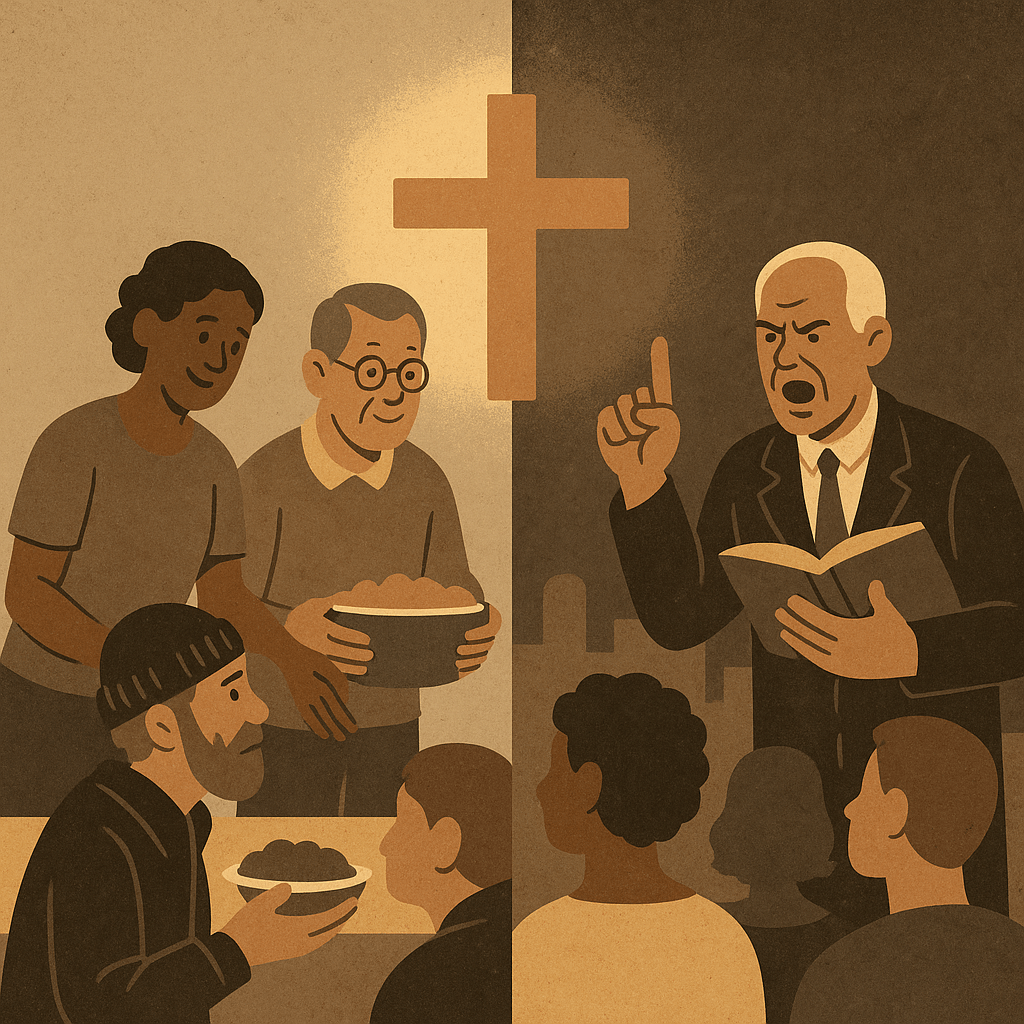
I once sat on a park bench in New Orleans, watching two very different scenes unfold before me. To my left, a church group served meals to people experiencing homelessness, their faces lit with purpose and compassion. To my right, a street preacher condemned passersby to eternal damnation, his voice sharp with certainty and judgment. Same faith, entirely different expressions. In that moment, the question before us today came into focus: Is religion bad?
Let’s begin with what we know to be true. For thousands of years, religion has been humanity’s primary tool for teaching children right from wrong. Before widespread literacy, religious stories transmitted moral lessons across generations. When formal education was rare, religious communities filled the gap, teaching values through parables and traditions that even the youngest could understand.
Religious communities have been there at our most vulnerable moments, the birth of a child, the death of a loved one, the celebration of a marriage, the marking of coming-of-age. They’ve provided frameworks for these transitions when our natural human need for meaning and community is at its strongest. When someone’s house burns down, it’s often religious communities who show up first with meals, clothing, and support.
In times of deep societal upheaval, religious institutions have provided stability and continuity. During the Civil Rights Movement, Black churches served as organizing centers for resistance and hope. Throughout history, religious communities have built hospitals, schools, and shelters, creating infrastructure of care long before government programs existed.
At their best, religions remind us we’re part of something larger than ourselves. They teach us to look beyond immediate self-interest toward the wellbeing of others. They preserve wisdom about human nature that remains remarkably accurate, wisdom about forgiveness, generosity, humility, and justice that science is only now confirming through research on human flourishing.
Yet we cannot discuss religion honestly without acknowledging its shadow side. The same certainty that gives comfort to believers can transform into rigid dogma that resists new understanding. The same community that embraces insiders can exclude or persecute outsiders.
History shows us religious wars where people killed in the name of the same God they claimed forbade killing. We’ve seen religious leaders exploit fear of divine punishment to control followers or accumulate wealth and power. We’ve witnessed religious institutions protect abusers while silencing victims in the name of preserving reputation.
Today, we see Christian nationalism, the dangerous fusion of religious identity with political power, threatening the very foundations of pluralistic democracy. This ideology reimagines America as an explicitly Christian nation where one particular religious interpretation should guide law and government. It distorts Jesus’s teachings about loving enemies and caring for strangers into justifications for policies that favor some and marginalize others.
Then there’s the matter of supernatural claims. Religions ask people to believe in events, virgin births, worldwide floods, people rising from the dead, that contradict everything we’ve learned through scientific inquiry. They often explain suffering through divine punishment or testing rather than natural causes, creating additional layers of pain for those already struggling.
Many religions teach children they are inherently sinful and deserving of eternal punishment, a psychological burden that can take decades to overcome. They sometimes discourage questioning, valuing faith over evidence, compliance over critical thinking.
Given these shadows, some conclude we’d be better off without religion entirely. But here’s where careful thinking is needed. The absence of moral teaching creates a vacuum, and nature abhors a vacuum.
Without frameworks for ethical understanding, what fills the gap? Often, it’s raw self-interest, tribalism, or the worship of power, wealth, or status. We’ve seen societies that attempted to eliminate religion entirely, Soviet Russia, Cambodia under the Khmer Rouge, where the result wasn’t enlightened humanism but rather totalitarian systems that treated human life as disposable.
When people have no moral framework, they become vulnerable to whatever ideology promises security or meaning. We see this today in young people raised without ethical foundations who fall prey to extremist ideologies online, finding in their absolute certainties the meaning they’ve been missing.
A society without moral teaching doesn’t become more rational, it becomes more susceptible to irrational influences, more fragmented, more driven by immediate desires rather than lasting values. Moral frameworks, whether religious or secular, provide essential guidance for navigating life’s complexities.
So where does this leave us? With the recognition that religion, like any powerful human institution, can be a force for tremendous good or tremendous harm. The question isn’t whether religion itself is bad, but rather how it’s interpreted and implemented.
When religion emphasizes compassion, justice, humility, and service, when it creates communities that support the vulnerable and challenge the powerful, it offers something vital to human flourishing. When it hardens into dogmatic certainty, exploitation of fear, or justification for discrimination, it becomes destructive.
Those of us on The Path recognize that religions were created during eras when controlling society often required fear-based motivation. The founders of these traditions didn’t have modern psychology, neuroscience, or sociology to guide them. They used the tools available, supernatural promises and threats, to encourage ethical behavior.
Today, we understand more about human motivation and flourishing. We know that intrinsic values and genuine connection drive lasting positive behavior more effectively than fear of punishment. We recognize that questions and doubt can deepen understanding rather than threaten it.
If you’re someone who finds meaning, community, and ethical guidance through traditional religion, The Path respects your journey. We share many of the same values, compassion for others, care for the vulnerable, the search for meaning beyond material success. We recognize that your religious community may provide vital support and structure that enhances your life and others’.
At the same time, we invite everyone, religious or not, to approach traditions with both appreciation and discernment. When religious teachings or communities promote compassion, justice, and human dignity, they deserve our respect and support. When they promote fear, exclusion, or unquestioning obedience, healthy skepticism is warranted.
After all, at their core, all major religious traditions contain profound insights about human flourishing. They teach us to look beyond self-interest, to care for the vulnerable, to find meaning in service to others. These insights remain valuable whether one accepts the supernatural elements or not.
In the end, perhaps the question isn’t whether religion is good or bad, but rather which aspects of religious traditions help humans flourish and which cause harm. By preserving what works while being willing to evolve beyond what doesn’t, we can honor the wisdom of the past while creating communities suited to our present understanding.
The park bench in New Orleans taught me something important. The same religious tradition that motivated one group to feed the hungry motivated another to condemn strangers. The difference wasn’t in their texts or traditions, but in which aspects they emphasized, compassion or judgment, inclusion or exclusion, love or fear.
As we walk forward together, some on traditional religious paths, some on The Path, some on entirely secular journeys, perhaps we can agree that the measure of any tradition isn’t its supernatural claims, but its practical effects on human lives. Does it make us more compassionate? More connected? More capable of building a world where all can flourish? These are the questions that matter, regardless of which path we choose.
Welcome to The Path. Let’s walk together.
 The Path
Leave a comment