
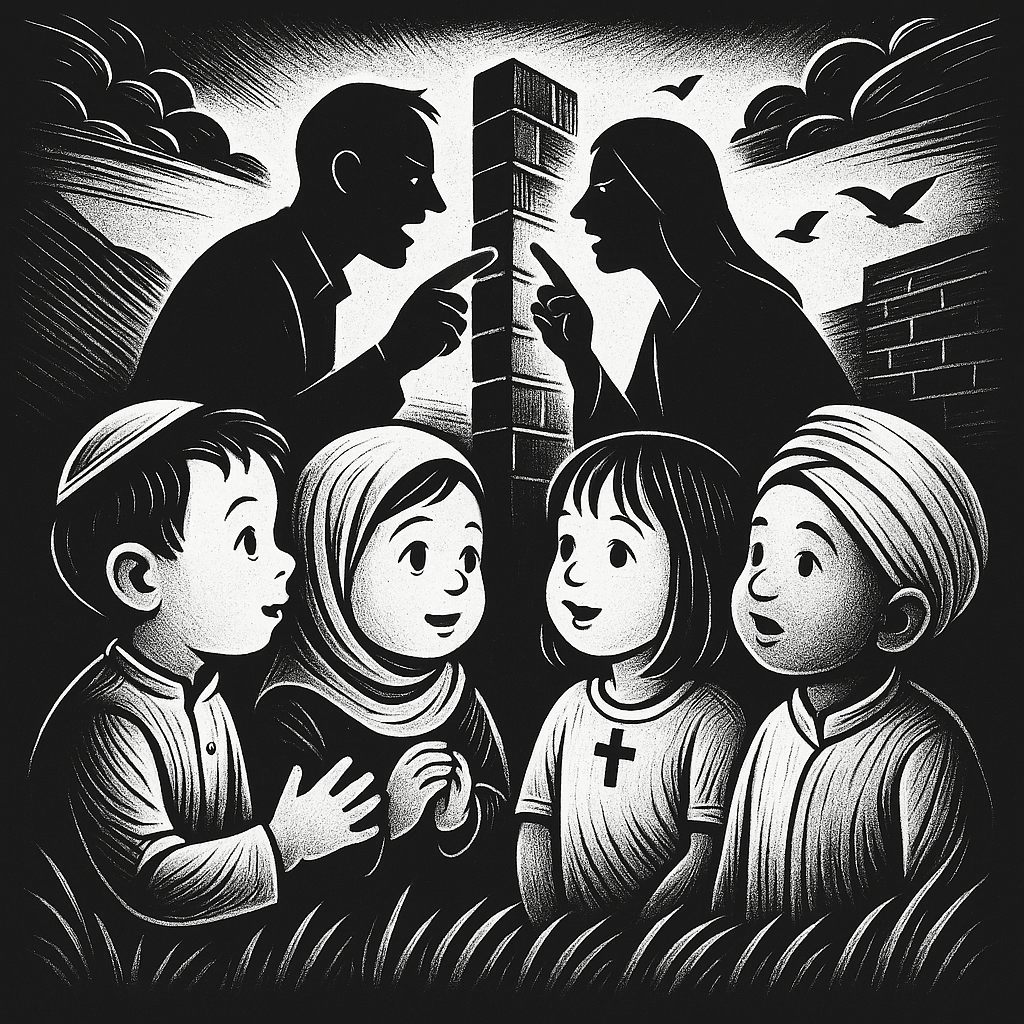
Children don’t choose their first words based on ancient grievances. A Jewish toddler learning to say “mama” sounds remarkably like a Palestinian child reaching for the same comfort. Muslim babies cry the same tears as Christian infants when they’re hungry or tired. Hindu toddlers laugh with the same infectious joy as Sikh children discovering bubbles for the first time.
Yet somewhere along the way, these same children learn to see each other differently. They inherit fears they never chose, adopt hatreds they didn’t create, and build walls where none existed before. The loving parent who soothes nightmares begins teaching daytime terrors. The gentle hand that wipes away tears starts pointing toward enemies. The voice that once sang lullabies begins whispering warnings about “those people” who cannot be trusted.
This is the tragedy that breaks my heart about religious and ethnic conflicts. Not the grand political struggles, though those matter deeply, but the way they train us to unsee each other’s humanity. The way they transform neighbors into enemies, children into soldiers, and love into a scarce resource that must be hoarded rather than shared.
When I read about violence erupting between communities, when I see headlines about attacks motivated by religious hatred, when I witness the cycles of retaliation that seem to have no end, I’m reminded of something fundamental that The Path has taught me. Behind every act of hatred is a human being who has learned to see other human beings as objects rather than people.
The recent tragic violence in Washington DC, targeting Jewish community members, represents just one painful example of a pattern we see repeated across the world. Whether it’s antisemitic attacks, Islamophobic violence, Hindu-Muslim clashes, or Christian persecution of minorities, the mechanism is always the same. Someone has been taught to see “the other” as less than fully human, as a symbol rather than a person, as an enemy rather than a fellow traveler on this difficult journey of being alive.
Traditional religious approaches to these conflicts often make things worse, not better. Religious leaders on all sides invoke divine authority for very human grievances, claim God’s exclusive favor for their people, and use sacred texts to justify what their traditions, at their best, would condemn. They take the natural human tendency toward tribal loyalty and weaponize it with supernatural certainty.
I’ve watched Jewish extremists claim that Palestinians aren’t fully human because they’re not God’s chosen people. I’ve seen Muslim fundamentalists argue that killing Jewish civilians is religiously justified because of political conflicts. I’ve witnessed Christian nationalists use biblical passages to defend discrimination against both Jewish and Muslim neighbors. In each case, religion becomes not a source of compassion but a justification for cruelty.
The secular response often isn’t much better. Academic discussions about historical grievances, political analyses of territorial disputes, and economic explanations for conflict all miss something crucial. They treat hatred as if it were a policy position rather than a deeply personal failure to see others as equally human.
But The Path offers a different approach, one that cuts through both religious justification and secular abstraction to address the human psychology that makes such conflicts possible.
Let me tell you about an Assembly gathering I witnessed in Brooklyn, where the discussion topic was “When We Cannot See.” The group included David, whose grandfather survived the Holocaust, and Amira, whose family fled persecution in their home country. Both carried generational trauma. Both had been taught, through experience and instruction, to be wary of the other.
During the first few meetings, they sat on opposite sides of the circle. David would tense visibly when discussions touched on Middle Eastern politics. Amira would grow quiet when anyone mentioned antisemitism. They were polite but distant, seeing each other through the lens of group identity rather than individual humanity.
Then something shifted during a discussion about parenting challenges. David shared his struggles helping his teenage son navigate social media bullying. Amira found herself offering practical advice, drawn from her own experiences with her daughter. As they talked, something remarkable happened. The labels dropped away. In that moment, they weren’t representatives of opposing communities. They were just two parents trying to protect their children in a difficult world.
“I realized,” David shared weeks later, his voice thoughtful, “that I had been seeing Amira as a Muslim first and a person second. But when she talked about her daughter’s struggles, I saw her as a mother. And once I saw her as a mother, I couldn’t unsee her as a human being.”
Amira nodded, tears in her eyes. “We carry so much pain from our families, from our histories. But that pain was keeping me from seeing that David carries pain too. Different pain, but still pain. Still the same human heart trying to protect what matters most.”
This is how healing begins on The Path. Not through theological reconciliation or political negotiation, though those have their place, but through the simple, revolutionary act of seeing others as fully human.
The Path recognizes that religious and ethnic conflicts persist because they serve psychological functions that go deeper than their stated grievances. They provide simple explanations for complex problems. They offer clear identities in an uncertain world. They give meaning to suffering by casting it as part of a cosmic struggle between good and evil.
But these psychological benefits come at a devastating cost. When we see conflicts through religious or ethnic lenses, we stop seeing individuals and start seeing symbols. The Jewish person becomes a representative of Israeli policies. The Muslim becomes a symbol of terrorist threats. The Christian becomes an embodiment of Western imperialism. The Palestinian becomes a stand-in for Arab aggression.
Once this symbolic thinking takes hold, violence becomes not just acceptable but righteous. We’re not hurting people, we tell ourselves, we’re fighting evil. We’re not destroying families, we’re defending our faith. We’re not perpetuating cycles of trauma, we’re honoring our ancestors.
The Path breaks this cycle by insisting on something radical: that every person we encounter is a complete human being with their own story, their own struggles, their own capacity for both love and fear. This doesn’t mean ignoring real political conflicts or dismissing legitimate grievances. It means refusing to let those larger issues blind us to the individual humanity of the people caught up in them.
I think of Hannah, a Jewish teacher in an Assembly who began corresponding with Palestinian educators through an international pen pal program. “I was terrified at first,” she admitted. “I expected anger, maybe even hatred. Instead, I found someone struggling with the same classroom management issues I face, someone who loves her students the way I love mine.”
Their correspondence didn’t solve the Israeli-Palestinian conflict. Hannah still supports Israeli policies that her pen pal opposes. Her correspondent still advocates for Palestinian positions that Hannah finds threatening. But something profound changed in how they see each other’s peoples. They can disagree about politics while affirming each other’s humanity.
“When I see news about violence now,” Hannah explained, “I don’t just see statistics. I think about families like my pen pal’s family. Real people with names and faces and dreams getting hurt. It doesn’t change my political views, but it changes how I hold them.”
This is the transformation The Path offers. Not the elimination of all disagreement, but the humanization of our opponents. Not the resolution of all conflicts, but the refusal to let conflicts dehumanize those caught up in them.
Consider what happens in an Assembly when someone shares their family’s traumatic history. Whether it’s the Holocaust, the Nakba, partition violence, or religious persecution, the response isn’t theological debate or political analysis. It’s witnessing, acknowledgment, and recognition of shared human vulnerability.
“We don’t have to agree about history to agree that families shouldn’t be destroyed,” one Assembly member observed after a particularly difficult conversation about generational trauma. “We don’t have to share the same narrative to share the same hope that our children will live in a more peaceful world.”
The Path’s approach to religious conflict rests on several key insights. First, that hatred is learned, not natural. Children don’t emerge from the womb fearing people of different faiths. They learn these fears from adults who were themselves taught to be afraid.
Second, that fear usually masks deeper human needs for security, belonging, and meaning. When someone expresses hatred toward another religious group, they’re often really expressing anxiety about their own group’s survival and significance.
Third, that proximity breaks down prejudice more effectively than distance reinforces it. When people from conflicting communities actually know each other as individuals, it becomes much harder to maintain group-based hatred.
Fourth, that shared experiences of vulnerability create bridges across even the deepest divides. Parents worrying about their children, elderly people facing mortality, workers struggling with economic insecurity, all these common human experiences transcend religious and ethnic boundaries.
Finally, that moral progress requires both individual growth and community support. Personal transformation happens in relationship with others who are also committed to seeing more clearly and acting more compassionately.
This doesn’t mean The Path offers easy solutions to complex problems. The structural issues that fuel religious conflicts, land disputes, resource competition, historical injustices, all require political and economic responses that go far beyond individual attitude changes.
But it does mean we can break the cycles of dehumanization that make these conflicts more brutal and intractable than they need to be. We can choose to see the Jewish mother in the café as a mother first and a representative of Jewish interests second. We can see the Palestinian father as a father first and a symbol of Palestinian nationalism second.
We can refuse to let our group identities eclipse our individual humanity. We can acknowledge historical traumas without using them to justify present cruelties. We can work for our communities’ security and prosperity without demonizing other communities trying to do the same thing.
The Path doesn’t ask anyone to abandon their cultural heritage or religious identity. What it asks is that we hold these identities lightly enough to see beyond them when we encounter other human beings. That we remember our shared humanity is deeper than our tribal divisions. That we recognize every person we meet is someone’s beloved child, parent, sibling, friend.
I return often to that truth about children’s first words and tears and laughter. That universal love that shapes those early moments exists in every community touched by religious conflict. It’s present in Jewish families and Palestinian families, in Muslim communities and Christian neighborhoods, in Hindu temples and Sikh gurdwaras.
The question is whether we’ll let that love guide how we see each other, or whether we’ll let fear and hatred blind us to it. The Path suggests that when we choose love, when we choose to see each other clearly, when we choose our shared humanity over our separate histories, we create possibilities for healing that seemed impossible before.
This isn’t naive optimism. It’s hard-won wisdom from people who have chosen to break cycles of inherited hatred. It’s practical guidance from communities that have learned to disagree about important things while affirming each other’s basic dignity.
It’s an invitation to anyone trapped in religious or ethnic conflicts to consider a different approach. Not the abandonment of your identity, but the expansion of your capacity to see others as equally real. Not the betrayal of your people’s struggles, but the recognition that other people’s struggles matter too.
In the end, the choice is simple even if it’s not easy. We can continue to see each other through the distorting lens of group conflict, or we can learn to see each other as we truly are: human beings trying to build meaningful lives for ourselves and those we love. The Path suggests that when we choose the latter, when we commit to seeing clearly and acting compassionately, we discover that our deepest hopes are not so different after all.
And in that discovery lies the seed of a different future, one where the mother feeding her child and the father helping with homework can look across the café and see not strangers or threats, but fellow travelers on this difficult and beautiful journey of being human.
Welcome to The Path. Let’s walk together.
 The Path
Leave a comment