
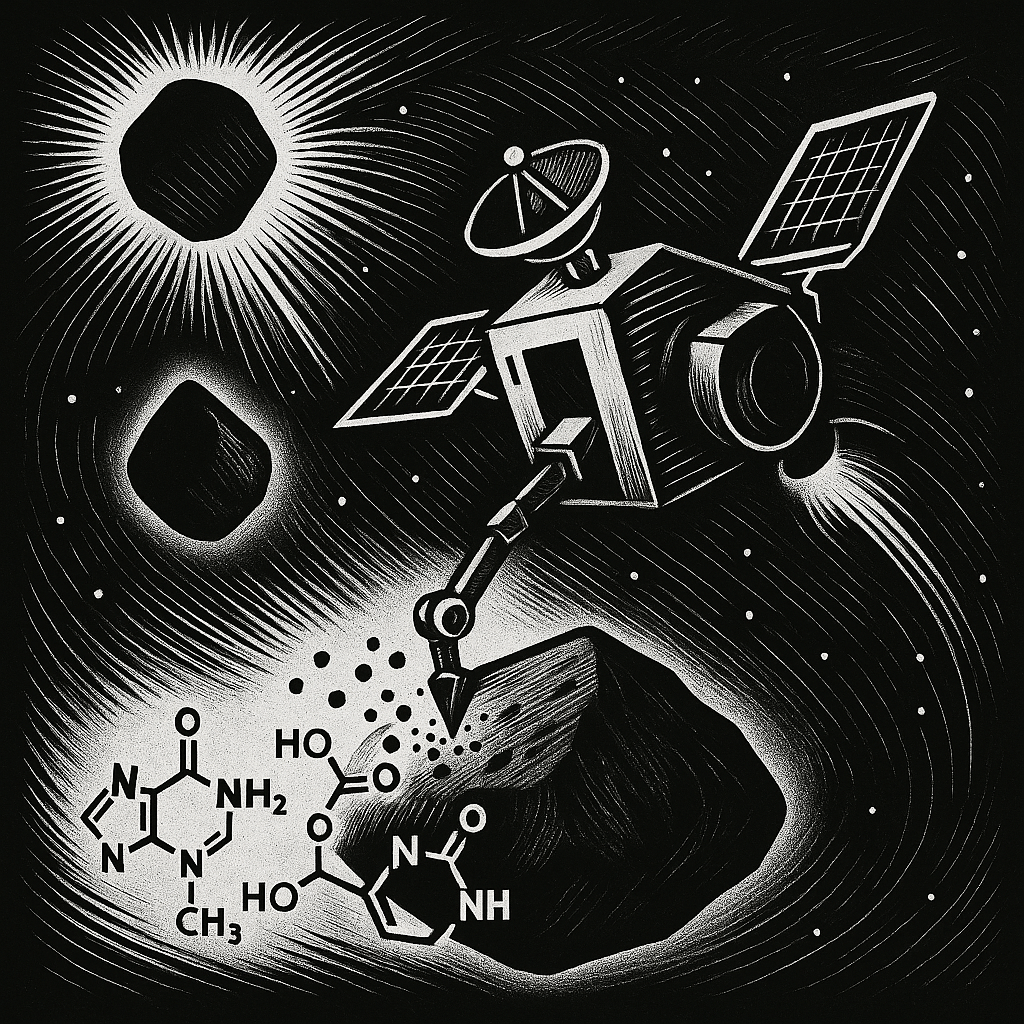
Picture, if you will, a small spacecraft no bigger than a school bus, traveling through the cold vacuum of space for seven long years. Its destination: an ancient asteroid named Bennu, a dark, diamond-shaped wanderer that has been circling our sun for billions of years. In 2023, NASA’s OSIRIS-REx mission accomplished something extraordinary. It reached out with mechanical precision, touched this cosmic remnant, and brought home a handful of pristine samples that would forever change how we understand our place in the universe.
When scientists examined these precious grains of cosmic dust, they found something that should make every human being pause in wonder. There, locked within this ancient rock, were the very ingredients of life itself. Fourteen of the twenty amino acids that build proteins in every living thing. All five nucleobases that form the backbone of DNA and RNA. The chemical foundations upon which every breath you take, every thought you think, every heartbeat that sustains you depends.
These weren’t contaminated samples from Earth. These were pure, untouched messengers from the deep past, carrying within them a story that spans not just our planet’s history, but the cosmos itself.
The Grand Narrative Unfolds
Let me take you on a journey through time, one that reveals the most magnificent story ever told. It begins billions of years ago, when our solar system was young and violent, filled with colliding rocks and cosmic debris. Among this chaos, asteroids like Bennu carried something precious: organic molecules forged in the nuclear furnaces of dying stars, chemistry set loose to wander the void.
When these space travelers crashed into the early Earth, they didn’t just leave craters. They delivered the raw materials for something unprecedented in our solar system’s history: life itself. From these cosmic ingredients, the first simple cells emerged, beginning a journey of increasing complexity that continues to this day.
Watch this story unfold like time-lapse photography of a garden growing. Photosynthetic bacteria learned to harvest sunlight, slowly filling our atmosphere with oxygen. Simple cells developed into complex ones, then discovered the power of cooperation, forming the first multicellular organisms. The Cambrian Explosion painted the ancient seas with an incredible diversity of life forms, each one an experiment in the art of existence.
For over 160 million years, dinosaurs ruled this planet, their reign ending only when another cosmic visitor, a massive asteroid, rewrote Earth’s story in fire and darkness 66 million years ago. But from that catastrophe came opportunity. Mammals, our distant ancestors, inherited a changed world and began their own remarkable journey toward complexity.
Eventually, primates developed larger brains and tool use. About 300,000 years ago, something unprecedented emerged: Homo sapiens, creatures capable not just of survival, but of wondering why they exist at all. We developed language and abstract thought. We created art and music. We asked questions that no other species had ever contemplated: Where do we come from? Why are we here? What does it all mean?
And crucially, we discovered something that would transform us from scattered bands into complex civilizations: the power of shared stories, moral frameworks, and collective meaning. We call this development religion, and it became the social glue that allowed thousands, then millions, then billions of humans to cooperate in ways that would have been impossible otherwise.
The Question That Bridges Science and Wonder
Here’s where our story becomes deeply personal. As humans developed the capacity for abstract thought, we inevitably confronted the biggest question of all: What lies behind this magnificent cosmic story? What is the source of the natural laws that govern everything from the formation of amino acids in space to the evolution of consciousness itself?
Scientists who engage deeply with these questions often find themselves describing something that transcends the physical universe as we understand it. They speak of an ultimate cause, a foundational source, a transcendent power that exists beyond space and time yet somehow underlies all existence. Many describe this as the first mover responsible for the Big Bang itself, the fine-tuning of physical constants that make life possible, the creative principle from which matter, energy, space, and time emerge.
This is remarkably similar to what we mean by “God” on The Path, though we approach it without supernatural claims or anthropomorphic imagery. When we contemplate the source of natural law, the origin of the mathematical principles that govern reality, the creative force that makes existence itself possible, we’re pointing toward something that science can describe but cannot fully contain or measure.
Consider the profound mystery embedded in our story. Why do natural laws exist at all? Why is the universe mathematically comprehensible? Why did chemistry organize itself into biology, biology into consciousness, consciousness into creatures capable of understanding their own cosmic origins? Science describes how these processes work with incredible precision, but the deeper question of why they exist at all remains a source of awe and wonder.
Where Science and Meaning Meet
The Path recognizes that this ultimate source, this creative principle we might call God, transcends empirical measurement. It’s not something we can put in a test tube or photograph with a telescope. Yet its presence is revealed through everything we can measure: the elegant mathematics underlying physics, the emergence of complexity from simplicity, the evolution of conscious beings capable of love, creativity, and moral reasoning.
When ancient teachers spoke of divine creativity, they were pointing toward this same mystery that modern scientists encounter. The difference is that we now have the tools to trace this creativity through cosmic time, from the formation of amino acids in the depths of space to the emergence of beings capable of contemplating their own existence.
This understanding transforms how we see ourselves and our place in the cosmos. We are not accidents or afterthoughts in a meaningless universe. We are the universe becoming conscious of itself, chemistry evolved to the point where it can wonder about its own origins. Every atom in your body was forged in the heart of an ancient star. The organic molecules that make your thoughts possible may have traveled for millions of years through space before finding their way to Earth.
You are quite literally made of star stuff, animated by the same creative principle that sparked the Big Bang, guided by natural laws so precise and elegant that they allowed unconscious matter to organize itself into conscious beings capable of love, wonder, and moral choice.
The Role of Meaning-Making
This brings us to religion’s crucial role in human development. As our species gained the capacity for abstract thought, we needed frameworks for making sense of our existence and organizing complex societies. Religion provided shared stories, moral guidelines, and social structures that enabled unprecedented levels of cooperation.
The Path acknowledges this vital function while updating our understanding based on scientific knowledge. Instead of supernatural myths, we can appreciate the actual cosmic story: how gravitational forces gathered dust into stars, how nuclear fusion created the elements of life, how chemistry organized itself into biology, how evolution guided the development of consciousness.
This scientific understanding doesn’t diminish the sense of wonder and meaning, it amplifies it. The more we learn about the universe’s actual history, the more remarkable our existence becomes. The probability that unconscious matter would organize itself into conscious beings capable of understanding their own origins is so astronomical that it fills any reflective person with profound awe.
Living Within the Great Mystery
Those who walk The Path find themselves part of this magnificent cosmic story, connected to both its scientific details and its deeper mystery. We’re material beings subject to natural law, yet we’re also consciousness reflecting on existence itself. We’re products of evolution, yet we’re capable of transcending purely biological motivations through reason, compassion, and moral choice.
This perspective provides a foundation for meaning that’s both scientifically grounded and spiritually fulfilling. We don’t need supernatural interventions to feel connected to something greater than ourselves. The natural universe, in all its complexity and beauty, provides more than enough reason for wonder, gratitude, and purposeful living.
When we gather in Assemblies to discuss these profound questions, we’re participating in humanity’s ongoing quest to understand our place in existence. We’re using our evolved capacity for abstract thought, language, and cooperation to explore the deepest mysteries together. We’re continuing the story that began with cosmic chemistry and led to conscious beings capable of love, creativity, and moral reasoning.
The Wonder That Unites All
Perhaps most remarkably, this understanding bridges the gap between scientific and spiritual perspectives. The scientist studying the organic compounds from asteroid Bennu and the philosopher contemplating the source of existence are exploring different aspects of the same profound mystery. Both are trying to understand how unconscious matter organized itself into conscious beings capable of seeking truth, creating beauty, and choosing good over evil.
This is the creative principle, the God of The Path: not a supernatural being demanding worship, but the ultimate source from which natural law emerges, the foundational reality that makes existence possible, the creative force that guides chemistry into biology, biology into consciousness, consciousness into beings capable of love and moral choice.
When we contemplate this cosmic story, from amino acids forming in space to humans capable of understanding their own origins, we’re witnessing the most remarkable thing imaginable: the universe becoming conscious of itself. Every scientific discovery, every act of compassion, every moment of wonder and gratitude is the cosmos reflecting on its own existence through evolved consciousness.
In this understanding, science doesn’t replace spirituality, it deepens it. Knowledge doesn’t diminish mystery, it reveals how much more mysterious existence really is. And the story that emerges, from cosmic chemistry to human consciousness, provides a foundation for meaning that’s both rationally grounded and spiritually profound.
This is the perspective The Path offers: a way of understanding our existence that honors both the scientific details of our cosmic history and the deeper questions of meaning and purpose that make us uniquely human. We are star stuff contemplating stars, chemistry wondering about its own origins, the universe experiencing itself through consciousness evolved over billions of years.
In that recognition lies both profound humility and unlimited wonder, both scientific understanding and spiritual meaning, both rational thought and transcendent awe. This is how we walk The Path: with gratitude for the cosmic forces that made our existence possible, with reverence for the creative principle underlying all existence, and with dedication to living in ways that honor both our evolutionary heritage and our capacity for conscious choice.
The journey from asteroid chemistry to human consciousness is the most remarkable story ever discovered. And we are not just observers of this story. We are its latest chapter, conscious beings capable of understanding our origins and choosing our future. In that responsibility lies both the challenge and the privilege of being human in a universe stranger and more wonderful than our ancestors ever imagined.
 The Path
Leave a comment