
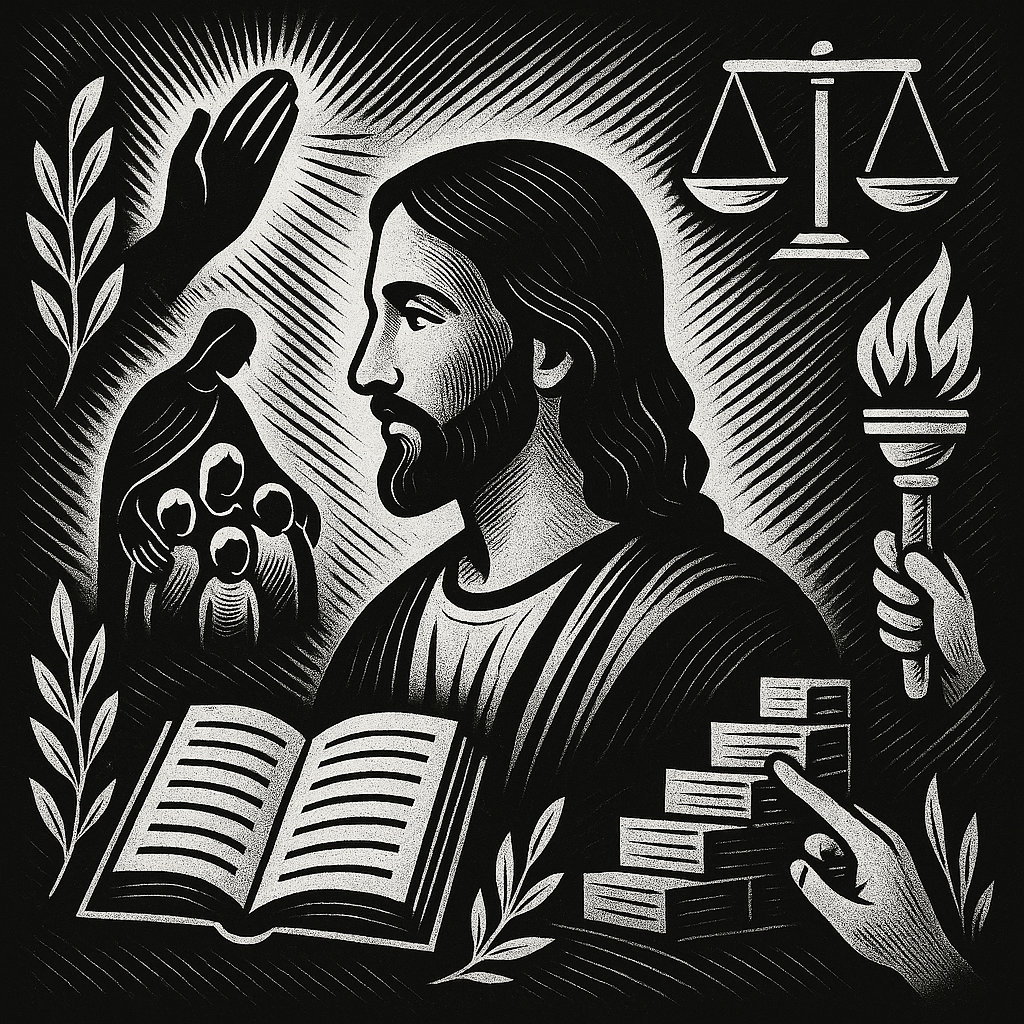
Picture watching the news with growing unease. Your children ask questions you struggle to answer. Your neighbors express fears about changes they see happening around them. In Assembly discussions, people share concerns about institutions they once trusted, about freedoms they thought were secure, about the direction of the country they love. These conversations carry a weight that feels different from typical political disagreements. Something deeper is stirring.
If you find yourself in this place, you’re not alone. Across the nation, families walking The Path are grappling with questions that go beyond partisan politics: How do we think clearly about troubling developments? How do we protect what matters most while maintaining our principles? How do we respond to concerning uses of power without losing ourselves in anger or despair?
For those of us who draw wisdom from Jesus’s teachings, moments like these demand we return to fundamental questions: What did this remarkable teacher tell us about power, justice, and moral courage? How do his insights guide us when institutions strain and democratic norms face pressure?
The Teacher’s Perspective on Power
Jesus lived under an authoritarian regime. Rome ruled through fear, crushing dissent, and concentrating power in the hands of the few. Religious leaders collaborated with political authorities to maintain control. Yet Jesus’s response wasn’t to retreat from moral questions or remain silent in the face of injustice.
Instead, he offered a framework for thinking about power that remains revolutionary: those who wield authority are accountable for how they use it, especially in their treatment of the vulnerable. When he saw religious leaders using their positions to burden rather than serve people, he spoke directly: “They tie up heavy, burdensome loads and put them on other people’s shoulders, but they themselves are not willing to lift a finger to move them.”
This wasn’t partisan politics. This was moral clarity about the proper use of authority.
Jesus consistently challenged the abuse of power, regardless of who held it. He criticized religious authorities who “devour widows’ houses” while making lengthy prayers for show. He condemned those who used their positions to exclude rather than include, to harm rather than heal, to divide rather than unite.
The pattern emerges clearly: those with power have a special responsibility to use it justly, and when they fail in this responsibility, speaking truth becomes a moral imperative.
Principles for Our Time
How might these teachings guide our thinking about concerning developments in our own time? Not by telling us which political party to support, but by providing principles for evaluation:
Protection of the Vulnerable: Jesus consistently stood with those who had the least power and the most to lose. When we witness policies that particularly burden children, immigrants, the poor, or minorities, his teachings suggest we pay special attention. Power used to further marginalize the already marginalized runs counter to everything he represented.
Truth and Transparency: Jesus valued truth above comfort or convenience. “You will know the truth, and the truth will set you free.” When institutions prioritize loyalty over honesty, when officials fire those who investigate wrongdoing, when transparency gives way to secrecy, we have reason for concern. Truth-telling, even when inconvenient, serves the common good.
Accountability and Humility: Those who follow Jesus’s teachings expect accountability from all who hold power. When officials claim they are above the law, when they refuse oversight, when they demand personal loyalty rather than institutional integrity, they embody the opposite of servant leadership.
Unity vs. Division: Jesus’s central message was about bringing people together, not driving them apart. While he didn’t avoid difficult conversations, his goal was always reconciliation and healing. When leaders consistently divide rather than unite, when they foster fear rather than hope, when they treat fellow citizens as enemies, they depart from this fundamental principle.
How to Think, Not What to Think
The Path doesn’t tell you which candidates to support or which political positions to take. But it does provide tools for thinking through troubling developments:
Ask Historical Questions: How have other free countries responded when institutions faced pressure? What patterns preceded the erosion of democratic norms elsewhere? History provides perspective on which concerns are reasonable and which responses have proven effective.
Examine Motivations: Jesus taught us to look at the fruits of actions, not just the stated intentions. When officials claim to serve the public interest, do their actions actually serve everyone, or do they benefit a select few? Do their policies increase justice and mercy, or do they concentrate power and wealth?
Consider Long-term Consequences: What kind of society do these actions create over time? If these precedents continue, what country will our children inherit? Jesus’s teachings focused on building something lasting and good, not just winning immediate battles.
Maintain Proportionality: Not every concerning development signals the end of democracy, but not every concern is mere partisan politics either. The Path encourages us to be neither alarmist nor complacent, but thoughtfully discerning about what deserves our attention and energy.
The Challenge of Civic Duty
Jesus lived in a time when ordinary people had little democratic power, yet he still engaged with questions of justice and governance. If you are in America you live in a democracy where your voices and votes matter tremendously. This creates both opportunity and responsibility.
The Path suggests that civic engagement isn’t optional for those who care about justice and human wellbeing. If we see policies that harm the vulnerable, if we witness the erosion of democratic norms, if we observe the concentration of power in ways that threaten long-term freedom, then our principles call us to respond.
But how we respond matters as much as whether we respond. Jesus’s approach was never to fight fire with fire, but to demonstrate a better way. This means:
Engaging with Truth and Grace: We can oppose policies without demonizing people. We can defend principles without abandoning civility. We can speak boldly while still treating opponents with respect.
Building Rather Than Just Resisting: Instead of only opposing what we don’t want, we work to build what we do want. We strengthen democratic institutions, support transparent governance, and model the kind of society we hope to create.
Acting Locally and Personally: While national politics captures attention, much of our influence lies in local communities. We can support vulnerable neighbors, volunteer for organizations that serve others, and demonstrate in small ways the values we want to see writ large.
Processing Fear and Uncertainty
Many families walking The Path feel genuine fear about current developments. These fears deserve acknowledgment and thoughtful response, not dismissal as political overreaction.
Jesus understood fear. He lived in dangerous times and faced powerful enemies. But his response wasn’t to retreat into isolation or surrender to despair. Instead, he focused on what remained within his control: his own actions, his relationships with others, and his commitment to truth and justice.
When we feel overwhelmed by large forces beyond our control, The Path suggests we follow a similar approach:
Focus on Your Circle of Influence: While you can’t control national politics, you can influence your local community. You can vote, volunteer, donate to causes you support, and have conversations with neighbors. You can raise children who understand justice and compassion.
Maintain Community Connections: Isolation breeds fear and despair. Stay connected with others who share your values. Participate in Assembly discussions. Find ways to work together on practical projects that make a real difference in people’s lives.
Practice Gratitude and Hope: Even in troubling times, much remains worth celebrating. Democratic institutions, though strained, continue to function. Communities still come together to help one another. People of good will still seek truth and justice. Acknowledging what’s good doesn’t mean ignoring what’s concerning, but it provides balance and perspective.
The Long View
Jesus’s teachings weren’t about winning short-term political battles but about building something lasting and true. His vision of justice, compassion, and human dignity has outlasted empires and inspired movements for freedom across centuries.
This perspective helps during uncertain times. The work of building just societies never ends. Each generation faces its own challenges and opportunities. What matters isn’t whether we live in perfect times, but whether we respond to our times with wisdom, courage, and love.
The current moment will pass, as all moments do. What will last are the choices we make, the relationships we build, the institutions we strengthen or weaken, and the example we set for those who come after us.
Moving Forward Together
Those walking The Path don’t all reach identical conclusions about specific policies or politicians. We come from different backgrounds and bring different perspectives to complex questions. What unites us is our commitment to evidence-based thinking, ethical reasoning, and community support.
This means we can disagree about tactics while sharing common values. We can debate specific responses while agreeing on fundamental principles. We can support different candidates while working together on local projects that serve the common good.
What we cannot do is ignore clear violations of the principles we hold dear. If we witness the targeting of vulnerable populations, the erosion of democratic norms, the concentration of power without accountability, or the deliberate spread of division and fear, then our values call us to respond.
Jesus didn’t give us detailed policy prescriptions for 21st-century America. But he gave us something more valuable: a framework for thinking about power, justice, and moral courage that transcends any particular moment or political system.
He taught us to protect the vulnerable, speak truth to power, hold leaders accountable, and work for the common good. He showed us how to oppose injustice without becoming what we oppose, how to fight for truth without abandoning love, and how to remain hopeful even in dark times.
These teachings don’t tell us exactly what to do, but they guide us in how to think. They don’t promise easy answers, but they provide reliable principles. They don’t guarantee immediate success, but they offer a foundation for meaningful action.
In Assembly discussions, as families process their concerns and seek wisdom together, these principles provide common ground. Whatever our specific political views, we can unite around the protection of the vulnerable, the importance of truth and accountability, and the necessity of civic engagement guided by ethical principles.
The question “What would the Teacher do?” doesn’t have simple answers in our complex world. But it points us toward the right questions, the enduring principles, and the kind of response that serves not just our immediate interests but the long-term flourishing of all people.
This is how we walk The Path in challenging times: with clear principles, honest assessment, community support, and the long-term perspective that comes from grounding our actions in wisdom that has endured across centuries. We may not control the storms we face, but we can control how we respond to them. And in that response lies both our challenge and our hope.
Welcome to The Path. Let’s walk together.
 The Path
Leave a comment