
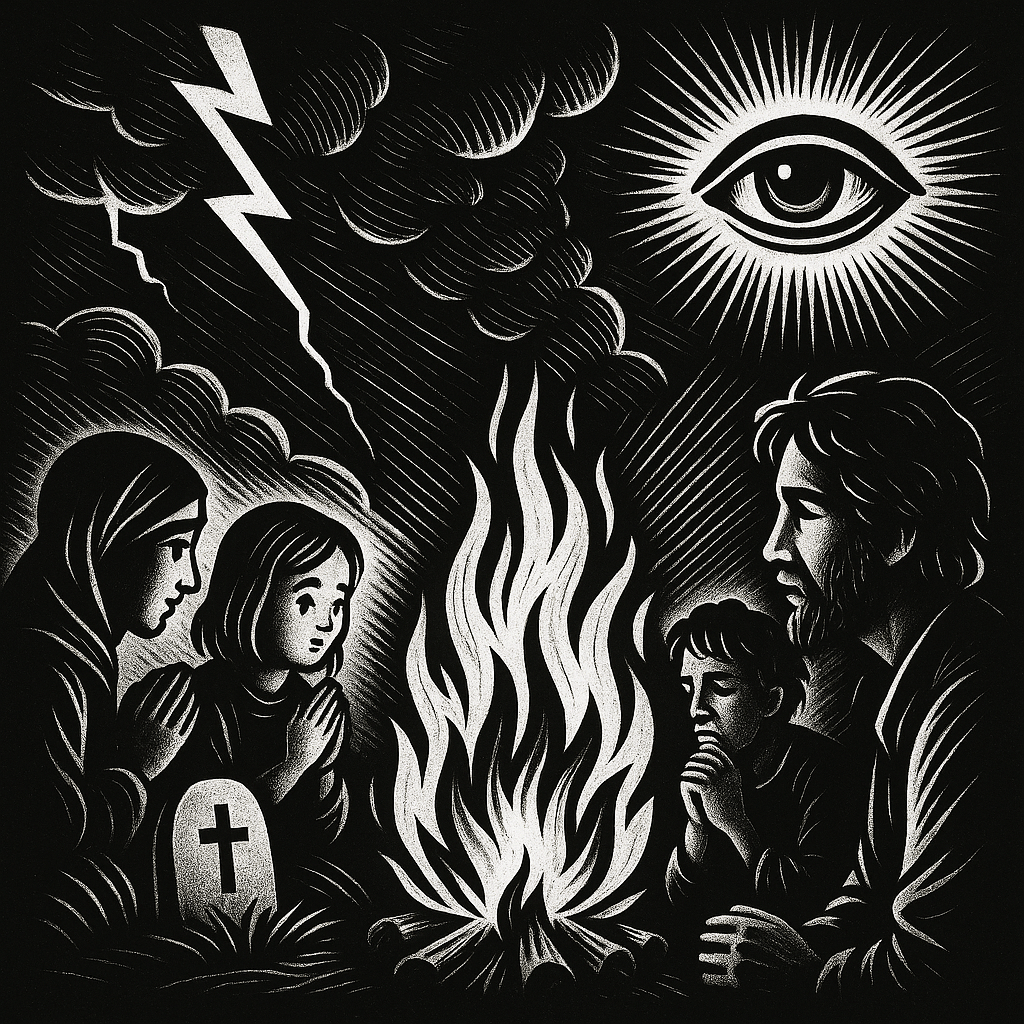
Picture a small band of humans, perhaps fifty thousand years ago, huddled around a fire as lightning splits the sky. They’ve just buried one of their own, and the questions hang in the air as heavy as the smoke from their fire: Where did she go? Why did this happen? What forces control our fate? These questions, as old as consciousness itself, gave birth to humanity’s most enduring invention, not the wheel, not agriculture, but religion.
You see, religion wasn’t some primitive mistake our ancestors made. It was a sophisticated technology for survival, as essential to early societies as fire or language. Every element that seems puzzling to modern minds (the all-seeing deity, the promise of paradise, the threat of damnation) each solved specific problems that threatened to tear apart the fragile fabric of human cooperation.
Consider what religion gave us. A shared belief in divine authority created something remarkable: strangers could trust each other because they answered to the same cosmic judge. When you believe someone fears the same hell you do, you’re more likely to trade with them, marry into their family, or fight alongside them. The gods became the ultimate contract enforcement mechanism in societies too large for everyone to know everyone else’s reputation.
Heaven offered something equally powerful: a reason to be good when no one was watching, and hope when life seemed hopeless. That farmer breaking his back in the fields, that mother losing child after child to disease, that soldier facing impossible odds, they could endure because paradise awaited. Hell, for its part, promised that the wicked would face justice, even if they escaped earthly punishment. Together, these concepts created invisible chains stronger than any prison walls.
The need for meaning burned just as bright. Humans, unlike any other creature we know, are aware of their own mortality. We know we will die. That knowledge could paralyze us with terror, but religion transformed death from an ending into a doorway. The divine plan gave purpose to suffering. The cosmic order made sense of chaos.
Our minds, evolved to detect predators in the bushes, naturally see intention everywhere, in storms, in sickness, in fortune good and bad. Gods filled that cognitive need, providing agents behind events that would otherwise seem random and terrifying. And perhaps most beautifully, the relationship with deity satisfied our deep need for connection, projecting onto the cosmos the love and protection we first knew from our parents
The Great Religious Solutions
Let me show you how different traditions addressed these universal needs:
| Religion | Followers (Approx.) | God Concept | Jesus-like Figure | Heaven Equivalent | Hell Equivalent |
|---|---|---|---|---|---|
| Christianity | 2.4 billion | Trinitarian God (Father, Son, Holy Spirit) or singular God | Jesus Christ – Son of God, divine savior | Heaven – eternal paradise with God | Hell – eternal punishment/separation from God |
| Islam | 1.8 billion | Allah – singular, absolute monotheism | Jesus (Isa) – revered prophet, not divine; Muhammad as final prophet | Jannah – paradise with Allah | Jahannam – hell, punishment for sins |
| Hinduism | 1.2 billion | Multiple approaches: Brahman (universal spirit), various deities (Vishnu, Shiva, etc.) | Avatar figures like Krishna, Rama; guru traditions | Moksha – liberation from cycle of rebirth | Naraka – temporary hell; negative karma consequences |
| Judaism | 15 million | Yahweh/Adonai – singular, monotheistic God | Messiah concept (future savior); some see Jesus as false messiah | Olam Haba – “world to come”; Gan Eden | Gehinnom – purification/punishment; less emphasis on eternal hell |
| Sikhism | 30 million | Waheguru – one formless God | Guru Nanak and subsequent gurus as divine teachers | Sachkhand – realm of truth, union with God | Separation from God through ego and ignorance |
| Shinto | 100 million | Kami – numerous spirits/deities in nature | Various kami; some deified historical figures | Takamagahara – high plain of heaven | Yomi – underworld, but not punishment-focused |
| Baháʼí Faith | 8 million | One God, unknowable essence | Bahá’u’lláh as manifestation of God; recognizes Jesus as previous manifestation | Spiritual worlds/paradise after death | Separation from God; spiritual suffering |
But then there’s something remarkable that emerged in ancient China – philosophical and spiritual systems that addressed these same human needs without personal gods, without heaven and hell as most understand them:
| System | Followers (Approx.) | Divine/Ultimate Reality | Teacher/Sage Figure | Ideal State | Negative State |
|---|---|---|---|---|---|
| Buddhism | 500 million | No supreme creator god; Buddha nature/enlightenment | Buddha – enlightened teacher; Bodhisattvas as guides | Nirvana – cessation of suffering | Samsara – cycles of suffering and rebirth |
| Taoism/Daoism | 12 million | Tao – impersonal universal principle/way | Laozi as legendary founder; immortal sages | Harmony with Tao; wu wei (effortless action) | Imbalance, forcing, struggling against nature |
| Confucianism | 6 million | Heaven (Tian) as moral order, not personal deity | Confucius, Mencius as moral teachers | Ren (humaneness); social harmony | Chaos, disorder, failure of virtue |
Look at this tapestry of human meaning-making. Christianity’s Trinity gave believers a God who could be transcendent Father, suffering Son, and present Spirit all at once, divinity that understood human pain because it had experienced it. Two and a half billion people find comfort knowing their God wore human flesh and wept human tears. The tradition offers Jesus Christ as Son of God and divine savior, with Heaven as eternal paradise and Hell as eternal punishment or separation from the divine.
Islam streamlined this into absolute monotheism, one God, indivisible, beyond human comprehension yet closer than your jugular vein. Allah needs no intermediary, no divine son to bridge the gap. This clarity has guided nearly two billion souls, offering them direct connection to the divine through prayer five times daily, creating a rhythm of remembrance that structures entire civilizations. Islam reveres Jesus (Isa) as a prophet but not divine, with Muhammad as the final prophet, offering Jannah as paradise and Jahannam as hell for punishment of sins.
Hinduism took a different path entirely, recognizing that different people need different faces of the divine. The warrior finds strength in Durga, the artist finds inspiration in Saraswati, the devoted lover sees God in Krishna. This multiplicity isn’t confusion, it’s recognition that the infinite can wear infinite masks. With over a billion followers, Hinduism approaches the divine through multiple lenses: Brahman as universal spirit, or various deities like Vishnu and Shiva. Avatar figures like Krishna and Rama, along with guru traditions, guide seekers toward Moksha, liberation from the cycle of rebirth, while Naraka serves as temporary hell where negative karma brings consequences. The cycles of rebirth transform death from a wall into a door, again and again, until the soul learns what it needs to learn.
Judaism, the ancient root from which Christianity and Islam grew, gave the world ethical monotheism, the idea that the one God (Yahweh, Adonai) cares passionately about justice. The concept of chosenness wasn’t about superiority but responsibility, a people tasked with demonstrating how to live in covenant with the divine. Their emphasis on this world over the next, on repair of the world (tikkun olam) rather than escape from it, shows how religion can focus on transforming life rather than transcending it. The fifteen million Jewish people hold a Messiah concept of a future savior, look toward Olam Haba (the world to come) and Gan Eden, with less emphasis on eternal hell than other traditions, viewing Gehinnom more as purification than permanent punishment.
Smaller traditions offer their own solutions. Sikhism’s thirty million followers worship Waheguru, one formless God, with Guru Nanak and subsequent gurus as divine teachers pointing toward Sachkhand, the realm of truth and union with God, while separation from God through ego and ignorance represents the negative state. Shinto’s hundred million practitioners find kami (numerous spirits and deities) in nature, with some deified historical figures, looking toward Takamagahara (the high plain of heaven) rather than a punishment-focused underworld like Yomi. The Baháʼí Faith’s eight million members believe in one God of unknowable essence, seeing Bahá’u’lláh as a manifestation of God while recognizing Jesus as a previous manifestation, understanding paradise as spiritual worlds after death and hell as separation from God and spiritual suffering.
Each system addressed the same core needs but tailored its solutions to its people’s circumstances. Desert peoples developed religions of absolute submission to overwhelming power. Forest peoples saw divinity in every tree. Ocean peoples found gods in the waves. The diversity isn’t failure to find the “right” answer, it’s evidence that humans everywhere faced the same fundamental challenges.
But then there’s something remarkable that emerged in the East, philosophical and spiritual systems that addressed these same human needs without personal gods, without heaven and hell as most understand them. Buddhism, with five hundred million followers, proposes no supreme creator god but instead emphasizes Buddha nature and enlightenment. The Buddha serves as enlightened teacher, with Bodhisattvas as guides, pointing toward Nirvana (cessation of suffering) as the ideal state, while Samsara represents the cycles of suffering and rebirth to be transcended.
Taoism proposed something radical: what if the ultimate reality isn’t a being but a way? The Tao that can be named is not the eternal Tao. Like water that defeats rock through yielding, like the empty space that makes a cup useful, the Tao works through what isn’t rather than what is. Twelve million people find meaning not in divine commands but in natural harmony, not in eternal life but in joining the eternal dance of transformation. With Laozi as legendary founder and immortal sages as guides, Taoism teaches harmony with Tao and wu wei (effortless action) as the ideal state, while imbalance, forcing, and struggling against nature represent the negative state.
Yet here’s what fascinates me: Taoism alone wasn’t enough. In China, it needed partners.
Taoism could teach you to flow like water, but it couldn’t organize a tax system. It could help you accept death, but it couldn’t run a school. Its beautiful philosophy of non-interference meant that when faced with corruption or oppression, it often counseled withdrawal rather than reform. “The Tao does nothing, yet nothing is left undone,” a profound truth for individual enlightenment, but try running a government that way.
So Confucianism emerged to handle what Taoism couldn’t, the messy business of actual human society. Where Taoism said “flow,” Confucianism said “here’s exactly how fathers should treat sons, rulers should treat subjects, friends should treat friends.” It created educational systems, governmental structures, and social hierarchies that could scale across millions of people. Without Confucian structure, China might have remained a collection of isolated villages rather than a continuous civilization spanning millennia. Its six million followers view Heaven (Tian) as moral order rather than personal deity, with Confucius and Mencius as moral teachers pointing toward Ren (humaneness) and social harmony, while chaos, disorder, and failure of virtue represent the negative state.
But even together, Taoism and Confucianism left a gap. They didn’t adequately address individual psychological suffering or provide detailed methods for spiritual development. Buddhism filled this void with sophisticated meditation techniques, psychological insights about the nature of suffering, and institutional structures (monasteries, teaching lineages) that could preserve and transmit wisdom across generations.
The Chinese discovered something profound: no single system could meet all human needs. They needed an ecosystem of wisdom traditions, each contributing what the others lacked. The scholar-official might be Confucian at work, Taoist in retirement, and Buddhist when confronting mortality. This wasn’t confusion or hypocrisy, it was practical wisdom.
Which brings us to The Path and its place in this great human conversation about meaning. Like Taoism, The Path doesn’t require belief in supernatural beings or divine intervention. There’s no angry God to appease, no heaven to earn, no hell to fear. Instead, it finds the sacred in the natural, in the emergence of consciousness from matter, in the bonds between human beings, in the scientific wonder of existence itself.
But unlike ancient Taoism, The Path doesn’t retreat from social engagement. It actively builds communities through Assemblies, regular gatherings where people support each other through life’s challenges, celebrate its joys, and work together for collective flourishing. Where Taoism often counseled withdrawal from worldly concerns, The Path says engage, but do so with wisdom informed by evidence and compassion informed by understanding.
The Path addresses each classic religious need through contemporary understanding. The need for meaning? Science reveals a universe of such magnificent complexity and beauty that it dwarfs any ancient creation myth. The need for community? Assemblies create bonds not through shared supernatural beliefs but through shared human experience and mutual support. The need for ethical guidance? The moral teachings of Jesus and other wisdom traditions, stripped of supernatural claims, proven by research, applied through reason.
Death anxiety? The Path doesn’t promise personal immortality, but it shows how we continue in the effects we have on others, in the knowledge we pass on, in the love we’ve shared, in the very atoms that made us returning to the cosmic dance. Justice? Not cosmic justice, but the human responsibility to create justice here and now, because if we don’t, no one else will.
But let me be honest with you. This approach isn’t for everyone. The Path requires a certain comfort with uncertainty that traditional religion doesn’t demand. When someone asks, “But what happens after I die?” The Path won’t give the definitive answer that Christianity or Islam provides. When someone wants to know why their child died, The Path won’t offer “God’s plan” as comfort.
For many people, especially those who haven’t had access to extensive education or who find abstract thinking difficult, the concrete imagery of traditional religion may always be more comforting than The Path’s naturalistic philosophy. And that’s perfectly fine. The Path isn’t trying to eliminate religion or convert believers. It’s simply offering an alternative for those who can no longer accept supernatural claims but still need community, meaning, and moral framework.
So here we stand at a unique moment in human history. For the first time, we have sufficient scientific understanding to explain the natural world without invoking supernatural forces. We have psychological insights that reveal how our minds create meaning. We have global communication that lets us see the full diversity of human wisdom traditions. We have social structures that can enforce cooperation without divine surveillance.
The question isn’t whether educated humanity is “ready” to move beyond religion. Millions already have, often painfully, leaving behind communities and comfort because they can no longer believe what they’re asked to believe. The question is whether we can build something that serves religion’s essential functions without its supernatural scaffolding.
The challenge is immense. Religion had thousands of years to develop its institutional structures, its rituals, its ways of marking life’s passages. It’s embedded in our languages, our calendars, our very assumptions about reality. Even those who reject religious belief often hunger for what religion provided: the community, the framework for living, the sense of connection to something greater than themselves.
Perhaps even more challenging: religion’s great power came from its certainty. “Thus says the Lord” carries more weight than “the evidence suggests.” The promise of eternal reward motivates differently than the satisfaction of living ethically. The fear of hell may deter wrongdoing more effectively than understanding natural consequences.
Can a movement based on reason and evidence inspire the same devotion as one based on faith? Can natural wonder compete with supernatural promise? Can human communities cohere without divine mandate? These aren’t abstract philosophical questions. They’re practical challenges that will determine whether movements like The Path can truly serve as alternatives to traditional religion.
Yet I find myself hopeful. Not because I think religion will disappear (it won’t and shouldn’t). But because humans are remarkably creative at building meaning-making systems. Just as our ancestors invented gods to meet their needs, we can invent new frameworks to meet ours. The Path may not be the final answer, but it’s part of humanity’s ongoing experiment in creating meaningful existence.
The beautiful truth? We don’t all have to walk the same path. But we do all have to walk. And in that walking, in that searching, in that very human need to find meaning and connection and purpose, in that, believers and seekers and skeptics are all part of the same magnificent human journey.
The question that remains is not whether we can live without religion, but whether we can build ways of living that honor both our need for meaning and our commitment to truth. The Path is one attempt. There will be others. And in that diversity, that experimentation, that continued evolution of human meaning-making, I find not loss but hope.
After all, the same creativity that invented gods can surely invent ways to live meaningfully without them. The same cooperation that built temples can build communities of mutual support. The same devotion that once served dogma can serve humanity itself.
That’s the real question, isn’t it? Not whether we’re ready to leave religion behind, but whether we’re ready to take responsibility for creating meaning, building community, and pursuing justice without waiting for divine intervention. Whether we’re ready to be the authors of our own purpose.
Some are. Some aren’t. And perhaps that’s exactly as it should be.
 The Path
Leave a comment