
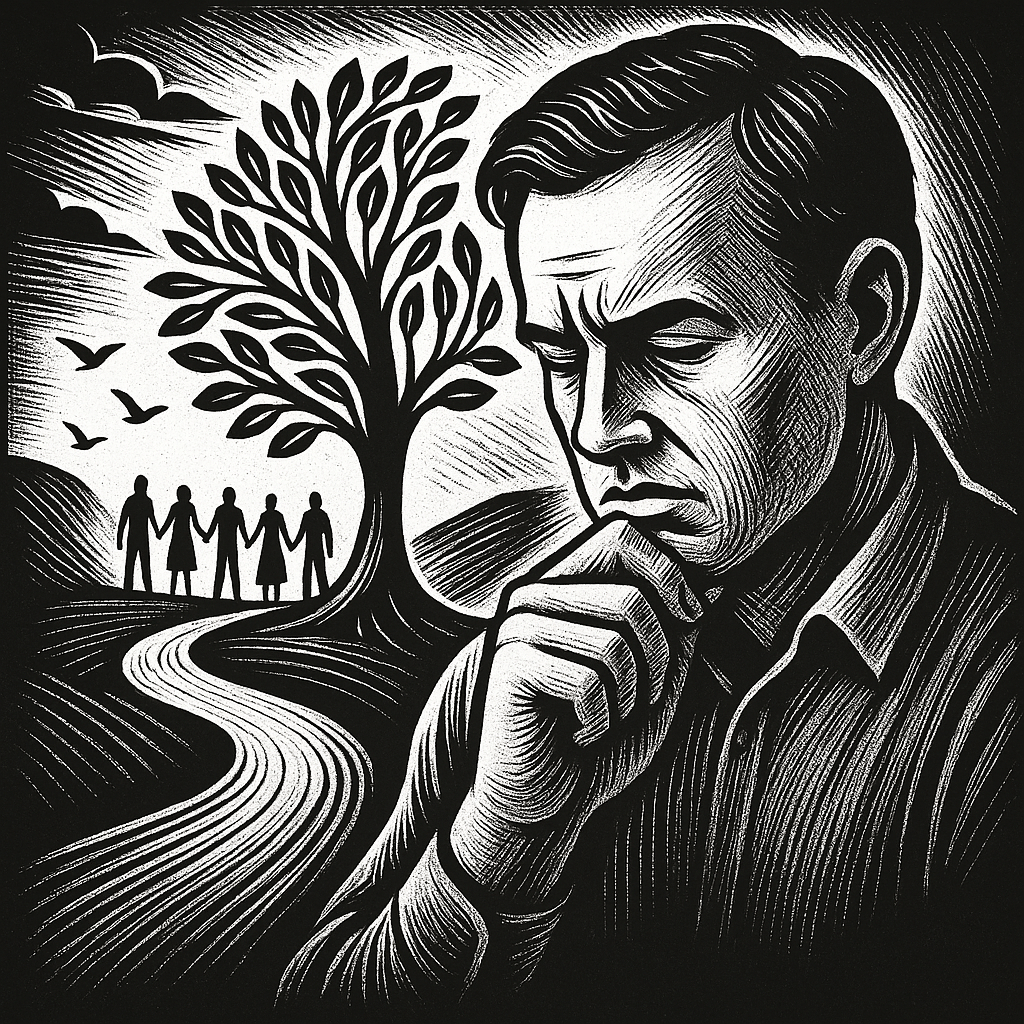
I once watched a heated conversation unfold at a coffee shop in Berkeley. A philosophy student was interrogating a woman about her beliefs, firing off questions like a prosecutor cross-examining a witness. “Are you religious or secular? Theist or atheist? Spiritual or materialist?” With each label he proposed, her face grew more uncomfortable. Finally, she set down her cup and said, “You know what? I’m Sarah. I care about my family, I try to help my neighbors, and I think we should treat each other with kindness. Why does everything else need a category?”
That moment captures something essential about The Path. We’ve learned that applying rigid labels to people is not just counterproductive, it’s fundamentally misguided. Everyone’s journey toward understanding is different. Everyone’s relationship with mystery, meaning, and morality is unique. The moment we try to squeeze the complexity of human experience into neat philosophical boxes, we lose something vital about what makes us distinctly human.
Yet I understand why people ask this question. In a world that loves categories, where dating apps ask for your religious views and political surveys demand you choose from dropdown menus, people want to know where they fit. So let me share what I’ve observed about those who walk The Path and how our approach relates to other philosophical positions.
The foundation of The Path rests on a simple recognition: human societies need shared moral and ethical principles to function. Without frameworks for teaching right from wrong, for encouraging compassion over cruelty, for promoting cooperation over chaos, communities fracture and civilizations crumble. We’ve seen this pattern throughout history. Remove the shared understanding of how humans should treat one another, and you get not enlightened freedom but social disintegration.
For thousands of years, religions provided these essential frameworks. They taught children to care for the vulnerable, to tell the truth, to forgive those who wronged them, to work for justice. They created communities that supported people through life’s transitions and challenges. They preserved wisdom about human nature that helped societies flourish.
But here’s where we must be honest about what we’ve learned. The traditional religious approach to moral teaching has become not just outdated but dangerous in our current era.
Consider how many religious institutions teach children they are inherently sinful and deserving of eternal punishment, creating psychological wounds that can take decades to heal. Think about how supernatural claims, virgin births and resurrections and worldwide floods, contradict everything we’ve discovered through scientific inquiry, forcing people to choose between reason and faith. Observe how religious certainty has been weaponized to justify discrimination, to resist social progress, to accumulate power and wealth while preaching humility and service.
Most troubling of all, witness how religious nationalism now threatens democratic institutions, how the same teachings that once promoted compassion are being twisted to justify exclusion and oppression. When religious leaders claim divine authority for very human political positions, when they use fear of divine punishment to control behavior and extract resources, when they demand unquestioning obedience to human interpretations of ancient texts, they’ve transformed spiritual wisdom into something that harms rather than heals.
This is why millions have walked away from traditional religion, and why The Path has emerged as an alternative. We recognize that the moral wisdom remains essential, but the supernatural framework has become a barrier to both truth and justice.
So how does this relate to other philosophical positions? Let me paint you some pictures.
Last month, I met David, a software engineer who proudly identifies as an atheist. “Religion is poison,” he told me over lunch, his voice carrying the certainty of someone who’d escaped what he saw as delusion. “It’s all mythology designed to control people. The sooner we abandon these ancient superstitions, the better off we’ll be.”
David represents one common atheist position: not just the absence of belief in supernatural claims, but active opposition to religious frameworks entirely. Many atheists see religion as fundamentally harmful, a relic of humanity’s ignorant past that we need to outgrow completely.
The Path shares the atheist rejection of supernatural claims. We don’t believe in virgin births or resurrections. We don’t think prayers change weather patterns or heal diseases through divine intervention. We see no evidence for heavenly rewards or hellish punishments in some afterlife.
But here’s where we diverge: we recognize that religious traditions contain profound insights about human flourishing that remain valuable even when stripped of supernatural elements. The teachings of Jesus about compassion, forgiveness, and justice aren’t invalidated by our rejection of his supposed divine nature. The community structures that religions created to support people through life’s challenges don’t become worthless because we don’t believe in the theological claims that originally motivated them.
David’s atheism, like many others, tends toward what we might call “hard materialism,” the view that reality consists only of matter and energy, that consciousness is merely brain activity, and that meaning must be entirely self-created. While The Path embraces scientific understanding, we remain open to the possibility that reality contains dimensions we don’t yet comprehend, patterns and connections that transcend simple materialism.
Then there’s Janet, a teacher I know who describes herself as agnostic. “I just don’t think we can know,” she explains, her hands gesturing toward some invisible uncertainty. “Maybe there’s a God, maybe there isn’t. Maybe consciousness survives death, maybe it doesn’t. The honest position is to admit we don’t have enough information to decide.”
Classical agnosticism, as formulated by biologist Thomas Huxley, holds that humans cannot know whether God exists or what the nature of ultimate reality might be. It’s a position of intellectual humility, acknowledging the limits of human knowledge and understanding.
The Path appreciates this humility. We don’t claim certainty about ultimate questions that may be beyond human comprehension. We recognize that the universe contains mysteries we may never fully solve, patterns and principles that operate beyond our current understanding.
But agnosticism often leads to a kind of philosophical paralysis. If we can’t know anything about ultimate reality, if all positions are equally uncertain, then we’re left without guidance for life’s practical questions. How should we treat others? What kind of communities should we build? How do we find meaning in the face of mortality?
The Path suggests we can acknowledge mystery while still making reasoned decisions based on available evidence. We can remain humble about ultimate questions while confidently affirming that compassion creates better outcomes than cruelty, that truth-seeking is more valuable than willful ignorance, that communities built on mutual support are stronger than those based on competition and exclusion.
This brings us to deism, and here’s where The Path finds its closest philosophical alignment.
Picture Thomas Jefferson in his study at Monticello, carefully cutting passages from his Bible with a razor blade. He’s creating what would become known as the Jefferson Bible, removing all supernatural elements while preserving the moral teachings he considered essential. Jefferson was a deist, someone who believed in what he called “Nature’s God,” a creative force that established the rational laws governing the universe but didn’t intervene in human affairs through miracles or revelations.
Deism emerged during the Enlightenment as educated people sought to reconcile religious insight with scientific discovery. Deists saw the universe as operating according to natural laws that could be discovered through reason and observation. They honored the wisdom found in religious traditions while rejecting supernatural claims that contradicted evidence and logic.
The Path builds on this deistic foundation while extending it further. Like deists, we see the universe as operating according to discoverable principles. We find meaning and moral guidance through reason, observation, and experience rather than through claimed revelations or supernatural interventions. We appreciate the profound wisdom contained in religious traditions while distinguishing between timeless insights and time-bound mythology.
But where traditional deism often remained abstractly philosophical, The Path emphasizes practical community building and ethical action. We don’t just contemplate natural law, we use our understanding to create better lives and stronger communities. We don’t just honor ancient wisdom, we apply it to contemporary challenges.
Consider Sarah, a member of an Assembly in Portland. When asked about her beliefs, she doesn’t immediately reach for labels. Instead, she describes her experience: “I find wonder in scientific discovery and meaning in ethical action. I see patterns in the universe that suggest something greater than random chance, but I don’t need to call it God or worship it through ritual. What matters to me is living according to principles that enhance human flourishing and building communities that support each other through life’s challenges.”
Sarah’s perspective captures something essential about The Path. We’re less concerned with metaphysical categories than with practical wisdom. We’re more interested in how we live than in how we label ourselves.
This doesn’t mean we avoid all philosophical reflection. The Testament, our foundational text developed collaboratively and available in our GitHub repository, explores these questions thoughtfully. Chapter 3, “Beyond the Supernatural,” examines how we can preserve religious wisdom while abandoning supernatural claims. The appendix on Deism traces our philosophical heritage while showing how we’ve evolved beyond traditional deistic positions.
But ultimately, The Path suggests that the question “What am I?” matters less than the questions “How am I living?” and “How are we growing together?”
If you find yourself drawn to The Path, you might discover elements that align with various philosophical traditions. Your respect for scientific evidence and rejection of supernatural claims might feel atheistic. Your humility about ultimate questions might feel agnostic. Your appreciation for the rational order underlying existence might feel deistic.
But here’s what I’ve observed: people who walk The Path tend to move beyond these categories toward something more integrated and practical. They become less concerned with defending philosophical positions and more focused on living ethical lives. They spend less energy debating metaphysical claims and more energy building supportive communities. They worry less about having the right beliefs and more about developing the right practices.
Marcus, a former philosophy professor who now facilitates an Assembly in Chicago, puts it this way: “I used to spend hours debating whether I was technically an atheist or an agnostic or a deist. Now I spend that time helping my neighbors, learning from scientific discoveries, and working with others to create the kind of community we all want to live in. The label matters less than the life.”
So if someone asks whether following The Path makes you an atheist, agnostic, deist, or something else, consider responding as Sarah did in that Berkeley coffee shop. You’re a person trying to live ethically in a complex world. You’re someone who values both reason and compassion, both scientific understanding and moral wisdom. You’re part of a community working to preserve what’s valuable from religious traditions while building something new and honest for our current era.
The Path invites you to be exactly who you are while growing into who you might become. It asks not for doctrinal conformity but for sincere engagement with life’s deepest questions. It offers not certainty about ultimate reality but companionship on the journey toward greater understanding and more consistent ethical action.
In the end, perhaps the most honest answer to “What does following The Path make me?” is simply this: more awake, more connected, more committed to the flourishing of all life. And in a world desperate for people who combine rational thinking with compassionate action, that identity might be exactly what we need.
The question isn’t whether you’re an atheist, agnostic, deist, or something else. The question is whether you’re ready to walk a path that honors both the mind’s need for truth and the heart’s hunger for meaning, that preserves ancient wisdom while embracing contemporary understanding, that builds communities of purpose in a world that desperately needs them.
Welcome to The Path. However you choose to label the journey, we’re glad you’re walking it with us.


 The Path
Leave a reply to a Teacher of the Path Cancel reply